
How To Read Match Intentions on Dating Apps
When using dating apps, understanding someone's intentions early on can save you time and energy. Here's how:
- Profiles Matter: Look for bios that mention specific relationship goals, hobbies, or personality traits. Avoid vague phrases like "open-minded" or "good vibes only." High-quality, recent photos showing personality are also a good sign.
- App Choice: Apps like Hinge and Bumble often attract users seeking serious connections, while Tinder can vary. Consistency across profiles on multiple apps can indicate sincerity.
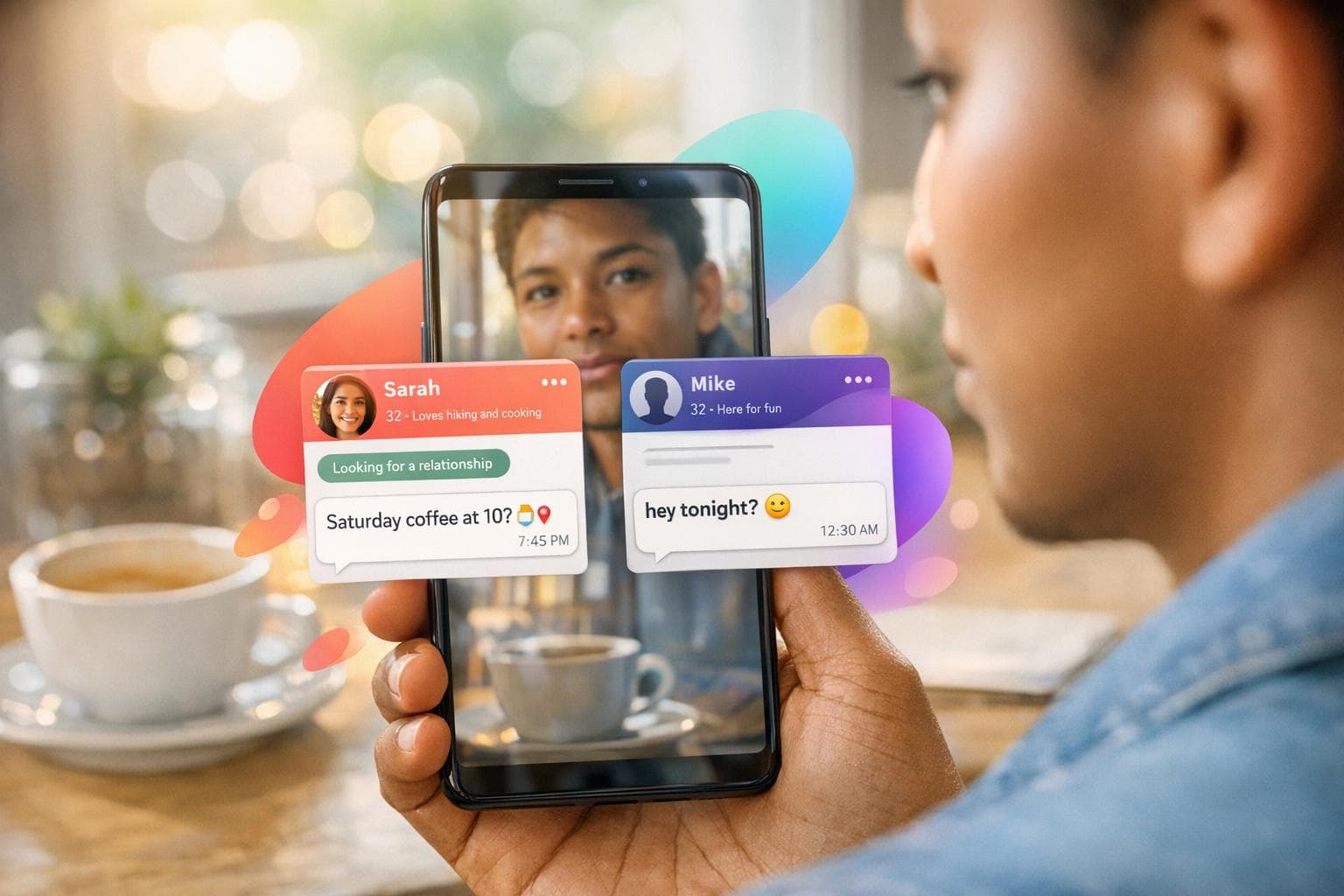
- Chat Patterns: Genuine matches ask thoughtful questions, show curiosity, and maintain consistent effort. Red flags include breadcrumbing, vague replies, or late-night-only texts.
- Date Planning: Serious matches suggest specific plans, follow through, and respect your time. Casual intentions often involve vague or last-minute invites.
- Follow-Up Behavior: After a date, matches who reference shared experiences and suggest future plans are likely interested in a deeper connection.
How to Spot Serious Intentions in Profiles
A dating profile is more than just a collection of photos and words - it’s a window into someone’s intentions. If you’re trying to distinguish between those seeking meaningful connections and those with casual goals, a few key details can provide clarity.
Check for Stated Relationship Goals in Bios
The language someone uses in their bio can reveal a lot about what they’re looking for. Research shows that people pursuing long-term relationships often highlight personality traits like being "loyal", "intelligent", or "self-confident." In contrast, those interested in casual connections may focus more on physical attributes and sexual appeal [7].
"Online daters looking for a long-term relationship mention more topics that are relevant when looking for a long-term relationship, such as internal personality traits and qualities." – Tess van der Zanden, Researcher [7]
Pronouns can also be telling. Serious daters often use "we" and "our", signaling a mindset geared toward partnership. Similarly, "you" and "your" references suggest they’re interested in learning about you, not just talking about themselves [7].
Pay attention to how specific someone is in their bio. Mentions of unique hobbies or interests, like "experimenting with breakfast recipes" or "reading WWII fiction", show effort and offer natural conversation starters [5]. On the other hand, generic phrases like "I love to travel" or "fluent in sarcasm" might hint at a lack of serious intent [8][5]. Interestingly, the most popular dating profiles tend to be 35% longer than average ones, indicating that time spent crafting a thoughtful bio often leads to stronger engagement [9].
Watch out for red flags too. Defensive language such as "no drama" or "don’t waste my time" can come across as jaded. Similarly, vague terms like "open-minded" or "good vibes only" may sometimes hint at casual intentions rather than a deep commitment.
While bios set the tone, photos often reinforce the message.
Evaluate Profile Photo Quality
The quality and content of someone’s photos can say a lot about their intentions. People seeking serious relationships tend to use recent, clear photos that highlight their personality and life - whether it’s showcasing hobbies, spending time with friends, or enjoying meaningful activities [11][7]. These types of images build trust and set realistic expectations.
"Skip overly sexy photos or ones you wouldn't show your family. Focus on authenticity and highlighting what makes you unique." – Julie Spira, Online Dating Expert [11]
In contrast, casual seekers might lean on provocative or overly polished images, such as shirtless selfies or poses designed to emphasize physical attraction [10][11]. Low-effort photos, like blurry images or bathroom selfies, can also suggest a lack of serious intent.
The stats back this up: high-quality photos can boost match rates by up to 272%. Smiling in photos further increases match rates - profiles with genuine smiles achieve a 34.2% match rate compared to 19.4% for more reserved expressions [12]. Additionally, having 4–6 varied photos can lead to 38% more matches than profiles with just 1–3 images [13].
If capturing the right photos feels challenging, tools like Dating Photo AI can help. These tools create authentic, high-quality images that highlight your personality while ensuring great composition and lighting - without making you look overly filtered.
Beyond bios and photos, the dating app someone chooses can also provide insights into their intentions.
What the Dating App Choice Reveals
The platform someone uses doesn’t just reflect their goals - it can shape their behavior. Certain apps encourage specific dynamics, whether it’s seeking immediacy or fostering deeper connections [15].
"If your app signals hook-ups, people show up ready for immediacy. If it signals relationships, they show up looking for depth." – Darshy N. [15]
Apps like Hinge or Bumble often attract users who are more intentional about dating. These platforms encourage detailed profiles and thoughtful prompts, helping users showcase their goals and personality [16][17]. Features like "Relationship Types" or "Dating Goal" badges allow people to clearly state what they’re looking for, reducing misunderstandings [14].
In contrast, casual apps are designed for quick interactions and spontaneity. That said, not everyone on these platforms is only looking for fun - 69% of Tinder users report wanting something serious, and a 2024 study found that 25% of recently engaged couples met on Tinder [14].
Since 60% of dating app users are active on more than one platform at the same time [15], consistency across profiles can reveal a lot. If someone’s tone and goals remain steady across apps, it’s often a sign of genuine intentions.
sbb-itb-06ba92c
What Chat Patterns Tell You About Intentions
After matching with someone, their texting habits can reveal a lot about their true intentions. With young adults sending an average of 109.5 text messages daily [18], these patterns can act as a window into how interested your match really is. Just like their profile details, the way they communicate through messages speaks volumes.
Spot Real Effort in Conversations
Effort is all in the details. Someone genuinely interested will ask open-ended questions that encourage storytelling rather than quick yes-or-no answers. Instead of a generic "Did you have a good weekend?" they might ask, "What was the highlight of your weekend?" [23]. They’ll also reference things you’ve mentioned before to keep the conversation lively and engaging [22].
A good conversation flows naturally. Matches who are serious will pick up on details from your profile or earlier chats to keep things moving. For instance, if you mention trying a new restaurant, they might ask what you ordered or share their favorite spot [23]. Research even shows that 85% of people are more likely to want a second date when their match asks thoughtful questions [23].
Balanced effort is another green flag. If you’re always the one starting conversations, it could signal that the effort isn’t mutual [20]. Look for signs of initiative, like your match sharing memes, sending morning check-ins, or introducing new topics on their own [22]. Using phrases like "we should" or suggesting specific plans can also indicate genuine interest [21][22].
"The way couples discuss ordinary events in their day reveals more about relationship health than how they handle major conflicts. It's the everyday emotional connection that predicts long-term success." – Dr. John Gottman, Relationship Psychology Researcher [20]
Watch for Warning Signs in Messages
Red flags in texting may not always be obvious, but certain patterns can hint at a lack of interest. One major warning sign is inconsistent reply times. If someone goes from replying within minutes to taking days without explanation, it could mean you’re no longer a priority [18][21]. Psychologist Katherine Hertlein explains:
"Once a texting pattern is established, slowing down to a different pace will be interpreted as lack of interest" [18]
Other signs of waning interest include inconsistent effort and one-word replies. Late-night texts might also suggest they’re only interested in a casual, time-limited connection [18][1][24].
Breadcrumbing is another common issue. This happens when someone sends just enough messages to keep you interested but avoids making real plans. Studies show that about 30% of dating adults have experienced breadcrumbing in the past year [24]. These matches might like your posts on social media but ignore direct messages or use vague phrases like "someday we should hang out" without committing to anything [1].
Beyond the frequency and content of messages, the tone your match uses can also reveal a lot.
Pay Attention to Tone and Interest Level
Tone often reflects emotional availability. Matches who are genuinely interested will maintain warmth and engagement in their messages rather than sounding like they’re going through the motions [19]. Fast response times can also signal genuine connection, though it’s worth noting that about 35% of adults occasionally forget to reply due to busy schedules [18].
A strong indicator of interest is whether your match contributes to a balanced, engaging dialogue. Do they ask about your life, or do they just answer your questions without showing curiosity? One-sided conversations can signal a lack of genuine interest [24]. For example, Dr. John Gottman’s research found that successful couples engage with each other roughly 100 times in ten minutes, compared to only 65 engagements among couples struggling to connect [20].
Even emoji usage can provide clues. A noticeable drop in emojis or exclamation marks from someone who used them frequently might suggest emotional withdrawal [18]. Emojis often act as emotional cues in digital chats [6], so their absence can make messages feel impersonal or detached.
Here’s a quick guide to interpreting messaging patterns:
| Signal Type | Messaging Behavior | Likely Intention |
|---|---|---|
| Green Flag | Quick, consistent replies; thoughtful follow-up questions; initiates contact; uses "we" language | Genuine Interest [22] |
| Yellow Flag | Vague plans; late-night only texts; future talk without specific dates; inconsistent responses | Casual/Uncertain [1] |
| Red Flag | One-word answers; cancellations without rescheduling; breadcrumbing; no follow-up questions | Disinterest/Casual [1][18] |
Consistency is key. Look at someone’s messaging habits over a two- to three-week period to spot patterns, rather than basing your judgment on a single interaction [1]. If you’re unsure, try mirroring their effort and response times for a week to see if the conversation stays alive without you doing all the work [1].
What Actions During Date Planning Reveal
Date planning offers a glimpse into a match's true intentions. While earlier we focused on textual cues, practical date planning shows whether those intentions hold up in real life. Transitioning from chatting to meeting often distinguishes casual interest from genuine commitment.
How They Plan and Follow Through on Dates
When someone is serious, they make specific plans. A thoughtful match will suggest an exact day, time, and place - like "Saturday at 2 PM, coffee at Main Street" - showing they value your time and aren’t treating you as an afterthought. They’ll also consider your interests, picking locations or activities that align with what you enjoy.
Reliability is another key sign. A dependable match will confirm plans ahead of time and show up as promised. If they need to cancel, they’ll apologize and immediately suggest another time. Henrik J. Klijn, Creative Director, explains:
"Low effort isn't always malicious... But either way, it tells you something important: how this person shows up when things are easy is how they'll likely show up when things get harder."[26]
If someone frequently claims to be "busy" without offering an alternative plan, it’s a clear signal you’re not a priority[1]. A genuinely interested person will find a way to reschedule without needing a prompt from you.
Watch Out for Late-Night or Vague Meetup Suggestions
Timing can reveal a lot about someone’s intentions. Daytime coffee dates, weekend afternoon walks, or weekday dinners often indicate a desire to genuinely connect. In contrast, late-night invites - especially after 9 PM - or drinks-only plans near their home can signal more casual motives[3].
Location matters, too. Thoughtful matches choose public spots like cafes, museums, or restaurants that reflect shared interests. On the flip side, a suggestion to meet at their house, a bar close to their place, or a casual "Netflix and chill" invite often points to a less meaningful connection[3].
Vague plans like "we should hang out sometime" are another red flag. They suggest low effort and interest. While 80.6% of dating app users say they’re seeking serious relationships, 45.4% admit they use the apps mainly to pass time or combat boredom[27]. Vague planning is a hallmark of this casual approach.
Communication After the First Meeting
What happens after the first date can confirm someone’s level of interest. Research from Hinge Labs shows that 75% of daters expect a follow-up message within a day, but 49% hesitate to send one, fearing they’ll seem overly eager[28][29].
A follow-up text within 12–24 hours that references a shared moment and suggests another date - like, "I had fun trying that Thai place - want to check out the art exhibit next Saturday?" - is a strong sign of genuine interest[25]. Studies even suggest that referencing a shared experience in your message can increase the chances of a second date by about 40%[30].
Consistency is key. After meeting in person, pay attention to whether your match maintains the same enthusiasm they showed before. Steady communication and effort after the first date are clear indicators of whether they see a potential future with you[26]. Next, we’ll look at how direct conversations can help solidify mutual understanding.
Warning Signs vs Positive Signs in Match Intentions
Dating App Match Intentions: Warning Signs vs Positive Signals Guide
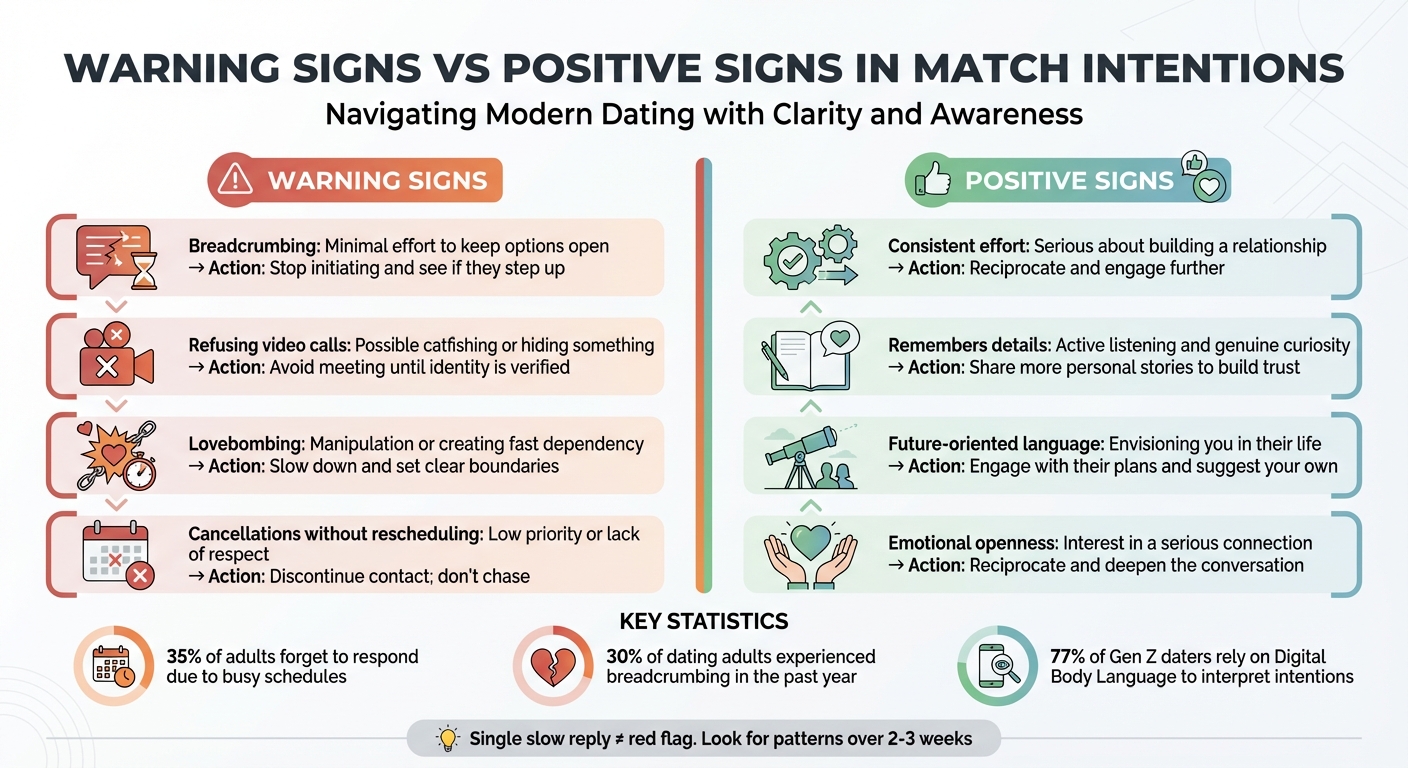
This section builds on earlier discussions about profiles, chat behaviors, and date planning by breaking down key warning signs and positive signals in match intentions. By comparing patterns in communication and actions, you can identify genuine interest and avoid mismatched expectations.
It’s important to note that a single slow reply isn’t necessarily a red flag - after all, 35% of adults admit they forget to respond because of busy schedules [18]. However, if someone repeatedly cancels plans without rescheduling or sends one-word replies for days on end, that’s a pattern worth paying attention to. As matchmaker Anna Morgenstern explains:
"The point of matching is to meet in person, not to have a pen pal." [31]
Actions should align with words. For example, if someone claims to want a serious relationship but only suggests vague, late-night meetups, it might be time to question their priorities. On the other hand, someone who remembers small details about you - like your pet’s name - and proposes specific plans for the weekend is signaling genuine interest.
Here’s a quick table summarizing common warning signs and positive signals:
Table: Warning Signs vs Positive Signs
| Signal | Intention Implied | Action to Take |
|---|---|---|
| Breadcrumbing | Minimal effort to keep options open | Stop initiating and see if they step up |
| Consistent effort | Serious about building a relationship | Reciprocate and engage further |
| Refusing video calls | Possible catfishing or hiding something | Avoid meeting until identity is verified |
| Remembers details | Active listening and genuine curiosity | Share more personal stories to build trust |
| Lovebombing | Manipulation or creating fast dependency | Slow down and set clear boundaries |
| Future-oriented language | Envisioning you in their life | Engage with their plans and suggest your own |
| Cancellations without rescheduling | Low priority or lack of respect | Discontinue contact; don’t chase |
| Emotional openness | Interest in a serious connection | Reciprocate and deepen the conversation |
The right match won’t leave you guessing. Dating coach Eddie Hernandez emphasizes this point:
"A guy who wants to meet up will let you know and ask you out. If a guy is not aiming to get to know you... move on." [3]
If warning signs continue over a period of 2–3 weeks, it’s better to focus your attention on matches who show consistent, positive behavior. In the next section, you’ll learn how to directly clarify someone’s intentions.
How to Clarify Intentions Directly
Once you've picked up on key signals from profiles, chats, and date planning, the next step is to ensure your goals align by directly clarifying intentions. The best way to avoid mismatched expectations is through open, honest conversations early on. This doesn’t mean grilling your matches with questions - it’s more about creating a comfortable space for genuine dialogue about what you both want.
Ask Clear Questions About Goals Early
Instead of diving in with a blunt "What are you looking for?", try a more conversational approach that encourages sharing. For example, you can use the Give and Take approach: share something about yourself first, then follow with a question. You might say, "I’m at a point where I’m focusing on building something real. Where do you see yourself in the next year or two?" [33].
Open-ended, values-based questions often work better than simple yes-or-no options. Questions like "How do you view communication in relationships?" or "What does a healthy relationship look like to you?" can reveal a lot about someone’s priorities without making them feel cornered [32][34]. Licensed professional counselor Allison Briggs emphasizes:
"Sharing your non-negotiables doesn't need to happen all at once or in a rigid way, but clarity is key" [32].
Timing is just as important as the questions themselves. While it’s wise to discuss intentions early, bringing up heavier topics like marriage or children over text - before even meeting - can come across as too intense [4]. Save those deeper conversations for a video call or your first date, once there’s a bit of rapport.
Use Video Calls to Verify Authenticity
A short 5–10 minute video call can be a game-changer. It not only verifies someone’s identity but also gives you a chance to get a sense of their tone, warmth, and personality - things that don’t always come through in text messages [35].
Dating coach Sandy Tran puts it this way:
"A video call adds a layer of safety by giving you a chance to verify who someone is before meeting in person. If they avoid it or make excuses, this could be a red flag" [35].
Keep the tone casual by suggesting something simple like, "I’ve found quick 5–10 minute chats make in-person dates so much better. Would you be open to a brief call?" This keeps the ask low-pressure.
During the call, pay attention to their digital body language - eye contact, how naturally the conversation flows, and how they respond to questions. A study found that 77% of Hinge users believe digital body language reveals a lot about someone’s intentions and interest [2]. If someone consistently avoids video or voice calls, it might be a sign they’re not being entirely authentic. This quick step can help set the tone for a smoother transition to meeting in person.
Move from Chatting to Meeting in Person
After exchanging 8–15 meaningful messages over a few days, it’s time to suggest an in-person meet-up. Make it specific and tie it to something you’ve discussed, like, "I noticed you love Italian food - there’s a great spot on Main Street. Are you free Saturday at 7:00 PM?" Then, follow up 24–48 hours before the date with a quick confirmation message like, "Still on for Saturday?" [4][36][37].
If your match repeatedly says they’re too busy without suggesting alternative dates, it might be a sign they’re not as invested. Marriage and family therapist Cheryl Groskopf explains:
"Dating with intention introduces conscious choice into the dating process. Where casual dating runs on momentum, intentional dating asks you to pause and consider how things are going at every step" [32].
Conclusion
When it comes to understanding someone's dating intentions, there are three key layers to pay attention to: profile details, communication, and follow-through. A well-crafted profile, meaningful conversations, and concrete plans reveal emotional readiness and sincerity. For instance, specific date plans carry far more weight than vague promises. Together, these layers create a reliable framework for evaluating potential matches.
Interestingly, 77% of Gen Z daters rely on Digital Body Language to interpret a match's intentions [2]. Every small detail - whether it's response times, tone in messages, or the way a profile is presented - speaks volumes. As Licensed Marriage and Family Therapist Moe Ari Brown wisely points out:
"Good communication [in dating] is being clear about your intentions from the very beginning" [2]
This guide has outlined how to assess intentions through every stage of dating, from analyzing profiles to observing chat dynamics and planning in-person interactions. By applying these strategies, you can focus your energy on connections that align with your relationship goals.
If you're ready to attract matches who genuinely align with your intentions, start by ensuring your profile reflects the real you. Tools like Dating Photo AI can help you create high-quality, authentic photos that stand out. Clear and up-to-date photos not only reduce ambiguity but also encourage meaningful conversations with the matches who matter most.
FAQs
How soon should I ask what they’re looking for?
It's a good idea to bring up intentions early in the conversation, but timing is key. Avoid asking right after matching, as it might come off as too direct. Instead, wait for a natural moment - typically after you've built some rapport during the first few exchanges. Asking too soon can feel abrupt, while waiting too long could lead to mixed signals. The goal is to raise the topic when the conversation feels easy and engaging for both of you.
What’s the difference between a slow reply and breadcrumbing?
A slow reply happens when someone takes a while to respond, often because they're busy or distracted - there’s usually no intentionality behind it. Breadcrumbing, however, is a calculated behavior. It involves sending sporadic, minimal interactions - like a random message or a casual like - just to keep you hooked, without any real intention of building a relationship. In short, slow replies are typically unintentional, while breadcrumbing is deliberate and manipulative.
When should I move from chatting to meeting in person?
It’s usually a good idea to plan an in-person meeting after about one to two weeks of steady messaging, especially if there’s a real sense of connection and mutual interest. Don’t rush the process - taking the time to build trust through conversations helps both people feel at ease. That said, waiting too long could risk losing momentum or missing out on a potential spark. The key is to meet when the connection feels solid and both parties are comfortable and ready.