

How AI Shapes Dating App Algorithms
AI is transforming dating apps, making them smarter and more user-friendly. Instead of relying on long questionnaires, AI now analyzes your swipes, messages, and interactions to suggest better matches. Here's how AI is changing the game:
- Photo Selection: AI helps users choose effective profile photos. For instance, Tinder's "AI Photo Selector" improved match rates by 71% for men with multiple face photos.
- Safer Platforms: Features like Tinder's "Are You Sure?" reduced harmful messages by 10%, while Bumble's "Deception Detector" blocks 95% of fake profiles.
- Smarter Matches: Apps use collaborative filtering and algorithms like Gale–Shapley for compatibility. For example, Hinge's feedback-driven "We Met" feature led to 72% of first dates resulting in second dates.
- Personalized Experiences: AI tools analyze bios, photos, and even chat patterns to suggest matches tailored to your preferences.
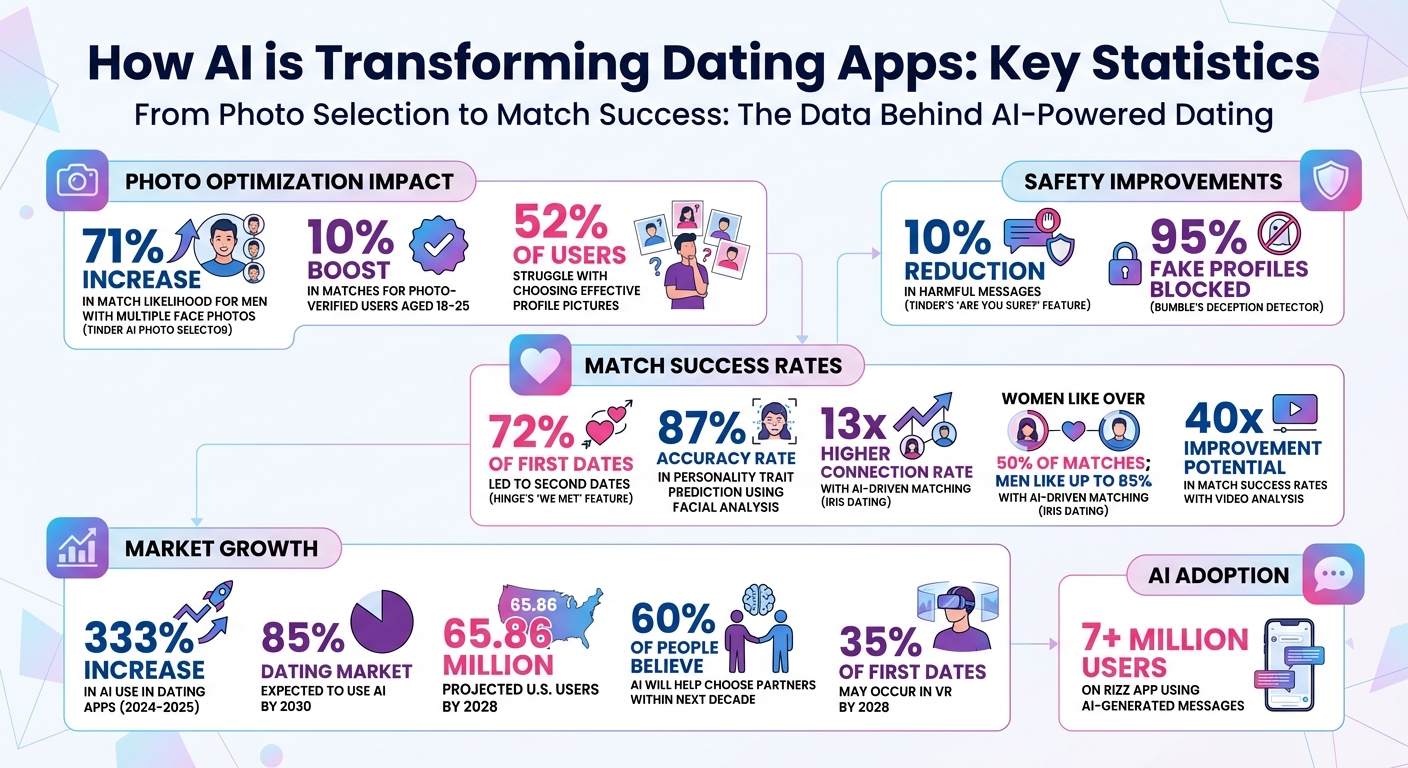
AI Dating App Statistics: Impact on Matches, Safety, and User Engagement
How AI is transforming the way people find love on dating apps
How AI Powers Dating App Algorithms
Dating apps use a mix of AI techniques to refine their matchmaking process. These systems dig into everything from your profile details to your swiping habits, continuously improving how they connect users. Let’s break down the key AI methods behind these matchmaking engines.
Profile Analysis and Similarity Scoring
AI starts by analyzing your profile and comparing it to others to gauge compatibility. OkCupid was an early adopter of this approach, asking users to answer thousands of questions. The platform then calculates match percentages based on shared answers, weighted by how important each user considers them [4][6].
Hinge takes a slightly different route, using the Gale–Shapley algorithm, which aims to create stable matches. Logan Ury, Hinge's Director of Relationship Science, explains:
"It pairs users inclined to mutually like each other" [6].
In 2018, Hinge introduced the "We Met" feature, where users provide feedback after dates. The results? A reported 72% of first dates led to second dates [5].
Collaborative Filtering for Match Recommendations
Collaborative filtering is another AI tool that tracks patterns among users with similar preferences. If your swiping habits align with someone else's, the algorithm suggests profiles that person liked but you haven’t seen yet. This method focuses on fostering mutual interest.
Tinder, for example, moved away from its old Elo desirability rating system. Instead, it now prioritizes factors like recent activity and engagement. As Tinder puts it:
"It's an outdated measure and our cutting-edge technology no longer relies on it" [7].
Natural Language Processing in Bios and Messages
Natural language processing (NLP) allows dating apps to analyze the text in your bio and messages. It doesn’t just look at what you say but also how you say it - helping to identify personality traits, communication styles, and subtle clues about compatibility.
Hinge CEO Justin McLeod envisions a future where this technology becomes even more advanced:
"Imagine a future where daters tell our algorithm in their own words what's important to them and what they're looking for. As a result, we will be better able to match them with a level of precision that up until this point hasn't been possible" [9].
Image Recognition in Profile Photos
AI also plays a big role in analyzing your profile photos. Image recognition tools pick up on visual cues like settings, activities, and even pets in your pictures. For instance, Tinder’s algorithm looks at these signals to suggest profiles with similar themes. According to Tinder:
"We'll suggest profiles with similar photos to ones members have Liked before... if members Like people enjoying the great outdoors, at festivals, or just enjoying the beach, we'll take the hint" [7].
In April 2025, Tinder introduced its "AI Photo Selector" feature, which uses Apple’s Vision framework and a custom TensorFlow Lite model. This system scores images based on their likelihood of receiving likes. It can process up to 1,000 photos at once, with users seeing noticeable improvements: men with multiple face photos saw a 71% increase in match likelihood, and photo-verified users aged 18–25 experienced a 10% boost in matches [2]. The technology even aligns facial landmarks to ensure your face is presented optimally, regardless of the original photo angle [8].
Other platforms, like Dating Photo AI (https://datingphotoai.com), also use image recognition to help users create standout profile photos that can elevate their chances of matching.
How to Optimize Your Profile for AI Algorithms
Fine-tuning your dating profile to align with AI algorithms can significantly improve your chances of finding better matches. Dating apps often reward users who clearly showcase their personality and preferences. By understanding how AI evaluates profiles, you can adjust your photos and content to send the right signals.
Why High-Quality Profile Photos Matter
Your photos are the first thing AI algorithms analyze. These systems evaluate technical aspects like lighting, composition, image clarity, and brightness to decide which profiles get more visibility [1,15,17]. As Faye Iosotaluno, CEO of Tinder, puts it:
"Our vision is to use AI as an enabler in the dating journey... to support our users in an area we've heard directly from them is one of the hardest parts of online dating" [10].
The numbers highlight why photo quality is key. Clear, high-quality photos can significantly improve match rates, yet 52% of users struggle with choosing effective pictures [1,15]. Verified profiles, especially for users aged 18–25 on Tinder, see a 10% increase in matches thanks to AI-driven photo verification [2].
Solo photos tend to work best because algorithms prioritize images where your face is clearly visible. Group photos can confuse the system, making it harder to identify who the profile belongs to, which often leads to those images being deprioritized [15,16,17]. Additionally, AI can pick up on emotional cues, favoring genuine smiles over neutral expressions [11].
AI also uses image recognition to detect contextual elements in your photos - like a beach, hiking trail, or gym - to better categorize your interests and match you with people who share similar lifestyles [4,17]. Essentially, your photos should tell a clear story about who you are.
If you’re unsure about which photos to use, tools like Dating Photo AI (https://datingphotoai.com) can help by using advanced AI to select or generate profile photos that align with what these algorithms prioritize.
Tips to Improve Your Profile for Better Matches
While photos are crucial, every detail in your profile contributes to how AI ranks and matches you. Here are some key strategies:
- Complete every section of your profile: Fill out all prompts, bio sections, and interest tags. Leaving parts blank can hurt your visibility, as incomplete profiles give less data for algorithms to work with [17,18].
- Stay active and engaged: Daily logins and meaningful interactions, like swiping and messaging, boost your profile’s visibility. For example, Tinder provides a boost for new users during the first 48–72 hours, and Hinge highlights newcomers with a "New Here" badge for up to 7 days. Algorithms also factor in the length and quality of your conversations [11].
- Swipe selectively: Avoid swiping right on every profile. Apps like Hinge caution that too many likes make it harder for the algorithm to understand your preferences, while too few likes limit the data it can analyze [12].
- Use built-in AI tools: Features like Tinder’s Photo Selector and Hinge’s "Top Photo" can help you identify your most impactful images. These tools use the same machine learning models that drive match recommendations [1,3].
- Update your profile regularly: Refreshing your photos and prompts signals to the algorithm that you’re active, which can improve your visibility and attract new matches [17,18].
sbb-itb-06ba92c
The Future of AI in Dating Apps
AI is already reshaping dating apps, and the future promises even more personalized and accurate matchmaking. Between 2024 and 2025, AI use in dating apps skyrocketed by 333%, and by 2030, it’s expected to dominate 85% of the market[13]. This evolution is changing how people connect, making matches more meaningful and tailored.
Better Compatibility Predictions
Future AI systems will dive deeper than ever into compatibility. Instead of just matching based on shared interests or preferences, advanced algorithms will analyze behavior, communication patterns, and emotional signals to predict long-term compatibility[13][16]. Some platforms are already exploring facial analysis to estimate personality traits, boasting an impressive 87% accuracy rate[13].
Imagine AI studying lifestyle clues from your photos - whether you love hiking, live music, or camping - and connecting you with others who share those passions[16][17]. In fact, Tinder tested a feature called "Chemistry" in Australia and New Zealand in late 2025, which does just that. According to CEO Spencer Rascoff, this feature is set to roll out globally by 2026[16][17].
AI will also transform how relationships are evaluated in real time. Algorithms will analyze chats to measure emotional balance, response timing, and communication flow, predicting relationship success rates[13][15]. Even video calls might be analyzed for subtle cues like laughter, vocal pitch, and eye contact, potentially improving match success rates by up to 40 times compared to current methods[13][15].
As compatibility predictions improve, the overall user experience will become more personalized.
More Personalized User Experiences
Dating apps are moving beyond the endless swipe culture to offer tailored, curated interactions. Match Group CEO Spencer Rascoff emphasized the shift by saying:
"We're entering a platform shift with AI... [It is] changing everything about the company's dating apps."[17]
Hillary Paine, Tinder’s VP of Product, echoed this sentiment:
"The more that we can do to get you efficiently to a spark and a connection, a conversation, hopefully a date, that's a better experience for you."[17]
Future AI could act as a personal concierge, handling swiping, matching, and even messaging on your behalf[1]. Apps like Rizz are already embracing this concept, with over 7 million users using its AI-generated opening lines and chat responses[1].
Some platforms are experimenting with biometrics to predict mutual attraction. For example, Iris Dating claims their AI-driven approach leads to women liking over 50% of their matches and men liking up to 85%, achieving a connection rate 13 times higher than traditional apps[14]. Looking ahead, there’s speculation that by 2028, 35% of first dates could take place in virtual reality settings[13]. Additionally, 60% of people believe AI will play a significant role in choosing their partners within the next decade[13].
However, this level of personalization requires users to share deeply personal data, such as photo galleries and chat histories, raising valid privacy concerns[13][16]. Justin McLeod, CEO of Hinge, offers a balanced perspective:
"While AI is not going to be a panacea when it comes to the very deeply and personal problem of love, I can tell you that it is going to transform the dating app experience, taking it from a do-it-yourself platform to an expertly guided journey."[9]
Conclusion: AI's Impact on Modern Dating
AI has reshaped the way people connect on dating apps, steering the industry away from endless swiping and toward curated matchmaking that emphasizes compatibility. Modern algorithms now assess behavioral patterns, communication styles, and emotional signals to foster more meaningful connections. By 2028, these advancements are expected to engage 65.86 million U.S. users[18]. As this shift unfolds, users need to adapt their profiles to stay relevant.
Tinder's November 2025 trial of "Chemistry" in New Zealand and Australia highlights this move toward AI-driven personalization[3]. The integration of AI into dating platforms is becoming a cornerstone for improving user experiences and creating deeper connections. As Liesel Sharabi, Associate Professor at Arizona State University, explains:
"Dating apps... are facilitating some of the most important decisions that you will ever make. People are using them to choose life partners... and we're letting AI help us make those choices"[1].
For users, keeping up with AI advancements means optimizing profiles to align with these algorithms. High-quality photos, for instance, play a huge role in success. Men who include multiple face photos see a 71% higher chance of matching[2]. Tools like Dating Photo AI address this need by using advanced technology to create standout images, helping users significantly increase their match rates across platforms. By simplifying photo selection and enhancing first impressions, Dating Photo AI offers a practical solution for modern daters.
Looking ahead, dating is set to become even more personalized and efficient. Imagine AI analyzing your photo library to highlight shared interests or predicting emotional compatibility based on chat patterns. The future of dating is about intentional matches, where presenting your best self through optimized visuals and engaging with AI-powered tools can lead to deeper and more genuine connections.
FAQs
How does AI make dating apps safer?
AI plays a key role in making dating apps safer by spotting and filtering out harmful or inappropriate content. For instance, it can automatically detect and block photos that break the rules - like those with nudity or multiple faces - helping to ensure profiles are both genuine and respectful.
Beyond images, AI also keeps an eye on conversations. It can flag offensive language or behavior and even prompt users to rethink messages that might come across as inappropriate. Together, these tools aim to reduce harassment and encourage more respectful and positive interactions, creating a more secure space for users to connect meaningfully.
How does AI help choose the best photos for dating profiles?
AI takes the hassle out of choosing the right photos for dating profiles by analyzing images and pinpointing those most likely to grab attention. It uses advanced algorithms to assess key elements like lighting, composition, and facial expressions, ultimately recommending photos that showcase users in the most flattering way.
This technology eliminates the uncertainty of photo selection, allowing users to present themselves confidently and improve their chances of forming connections. By adapting to current trends and preferences on dating platforms, AI ensures profiles not only stand out but also perform more effectively.
How can users make their dating profiles stand out to AI algorithms?
To make your dating profile stand out to AI algorithms, start with clear, high-quality photos that truly reflect who you are. AI systems often assess elements like lighting, clarity, and composition, so it’s worth selecting images that are well-lit and visually appealing. Avoid group photos or blurry shots - your profile should focus on you.
Mix it up by including solo photos that show off your hobbies or interests. These not only make your profile more engaging but also help AI algorithms better understand and present your personality. Since many platforms use AI to gauge compatibility, keeping your photos authentic and distraction-free can go a long way in improving your matches.
If you want to take things up a notch, you might try tools like Dating Photo AI. This technology can enhance your images, making them sharper and more eye-catching, which could increase your profile’s visibility and attract more attention.