

How AI Rates Your Dating Photos
Your dating profile photos are the most important part of your profile - they influence up to 80% of your match rate. AI tools now analyze and improve these photos by evaluating technical aspects like lighting, composition, and facial expressions. The process is quick, using advanced models to detect flaws and suggest improvements. Profiles with AI-optimized photos see match rates jump by as much as 230%.
Key takeaways:
- Lighting matters: Poor lighting can cut matches by 40%.
- Expressions count: A genuine smile boosts attractiveness 3–4x more than a neutral look.
- Avoid common mistakes: Group photos, sunglasses, and cluttered backgrounds lower match rates significantly.
AI tools like Dating Photo AI can generate polished, realistic images in minutes, offering a cost-effective alternative to traditional photoshoots. Users report dramatic improvements in matches and connections when using these optimized photos.
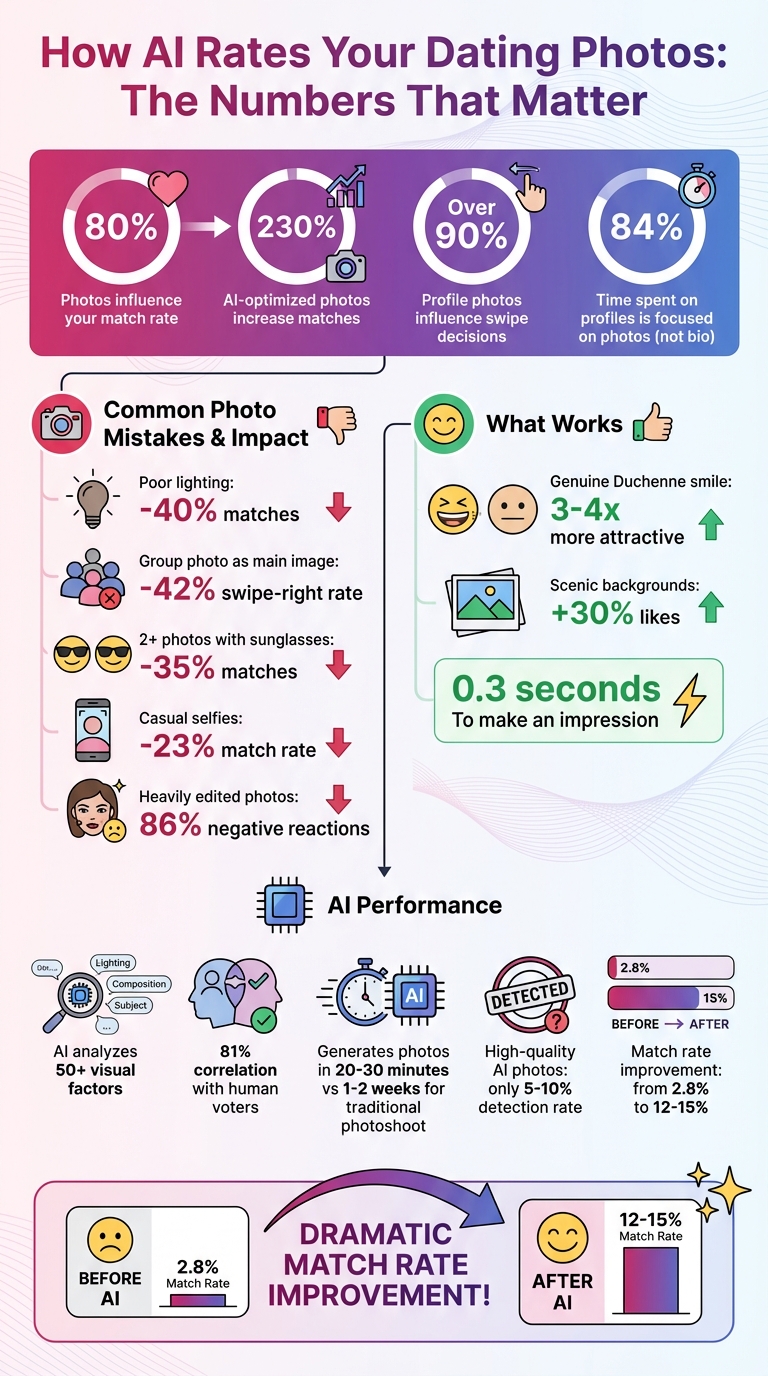
How AI-Optimized Dating Photos Impact Match Rates: Key Statistics
Spark, A.I Dating Coach Photo Ranker
sbb-itb-06ba92c
The Problem with Picking Profile Photos
Choosing the perfect dating profile photo is no small task. Without clear feedback, you might unknowingly pick an image that sends the wrong message - like appearing unapproachable when you’re aiming for confident. This disconnect can cost you matches, but it’s something AI tools are now stepping in to help with.
Generic advice like "smile more" or "show your hobbies" doesn’t cut it. The reality is, you have just 0.3 seconds to leave a lasting impression[8]. Even small details, like a cluttered background or closed-off body language, can lead to a quick left swipe.
Then there’s the issue of looking “too serious.” While a neutral or stern expression might feel cool, it often comes across as distant or intimidating. On the other hand, a genuine smile - one that lights up both your eyes and mouth - can make you 3–4 times more attractive[1]. The challenge, of course, is capturing that natural, engaging moment.
How Bad Photos Hurt Your Profile
A poor photo doesn’t just turn off potential matches - it can also hurt your standing with dating app algorithms. These platforms track engagement, and if your photos don’t get enough right swipes, your profile’s visibility takes a hit. Fewer views lead to fewer matches, creating a cycle that’s hard to break[8].
The stats back this up. Using a group photo as your main image can slash your swipe-right rate by 42%[1]. If two or more of your photos feature sunglasses, expect 35% fewer matches[1]. Even relying too heavily on casual selfies can cut your match rate by 23%[8]. These numbers highlight just how much of a difference the right photo can make.
"If people have to work to figure out what you look like, you'll get fewer matches, plain and simple." - Photofeeler[9]
And here’s the kicker: 84% of the time people spend on your profile is focused on your photos, not your bio[8]. A weak first image might mean they never even bother to read about you, leading to missed opportunities for connection.
What People Want to Show in Their Photos
Your photos need to strike a tricky balance: you want to appear attractive, confident, and approachable all at once. Achieving this requires careful attention to your expression, lighting, angle, and setting[8]. It’s not just about looking good - it’s about looking genuine and inviting.
People also struggle with what to include beyond their main photo. Should you highlight your full body, showcase your hobbies, or include friends? Omitting a full-body shot can raise doubts, while too many group photos might leave potential matches confused about which person you are.
Social media has added another layer of complexity. Constant exposure to idealized, filtered images has skewed what we perceive as attractive. This "Mere Exposure Effect" can lead you to pick photos that look great on Instagram but feel fake on dating apps. In fact, 86% of users report negative reactions to heavily edited pictures[5].
Understanding these common mistakes lays the groundwork for exploring how AI can step in to evaluate your photos and help you make better choices.
How AI Evaluates Dating Photos
AI uses advanced tools like convolutional neural networks (CNNs) - specifically models like Xception - to analyze your photos, breaking them down into thousands of data points[6][11]. These systems, trained on millions of images and over 10 million human ratings, are designed to understand what makes a photo successful in the dating world[6].
The process involves creating "photo vectors" (digital representations of visual elements) and "bias vectors" (indicators of varying human opinions)[6]. Essentially, the AI examines both the technical elements of your photo and simulates diverse human perceptions to gauge its overall appeal. This data helps pinpoint areas where your photos might fall short, giving you the chance to improve them for better matchmaking results. Now, let’s dive into the specific elements AI evaluates when rating your photos.
What AI Looks For
AI evaluates dating photos based on a variety of technical and aesthetic factors. On the technical side, it identifies issues like harsh shadows, overexposed areas, low-light grain, and imbalances in color temperature (whether the photo appears too warm or too cool)[1]. Lighting alone plays a major role - poor lighting can reduce your match rate by as much as 40%[1].
Facial analysis is another key area. AI detects genuine "Duchenne smiles", checks for head tilt and eye contact, and even notes signs of facial tension, such as clenched jaws or forehead wrinkles[1][4].
When it comes to composition, the AI applies principles of photography like the rule of thirds, proper headroom, and clean cropping. It also flags distractions in the background that might draw attention away from you[1]. Beyond technicalities, it examines lifestyle and social cues, such as whether you’re in an engaging setting (like a hiking trail or a cozy café), how your outfit complements the scene, and whether other people in the photo enhance or detract from the focus on you[1][7].
Modern AI models have also started prioritizing authenticity. They favor photos with natural skin textures - pores and all - and sharp backgrounds over heavily edited images with overly smooth skin or artificial blur effects[5]. This shift aligns with user preferences, as 86% of people report negative reactions to overly edited photos[5].
How AI Scoring Works
AI scoring takes all these observations and translates them into match-predictive ratings. Multiple neural networks work together to assess not just attractiveness but also perceived trustworthiness and intelligence, creating a well-rounded profile of your photo's appeal[4][6]. For example, systems like Photofeeler-D3 have achieved an impressive 81% correlation with human voters, a vast improvement over earlier models that only reached 53%[6].
These systems also account for individual biases. Some people tend to rate photos more harshly, while others are more lenient. By simulating hundreds of these varied perspectives, the AI produces an aggregate score equivalent to averaging the opinions of 15 human voters[4]. As researchers Agastya Kalra and Ben Peterson explain:
"Individuals tend to be consistent in the way they respond to other peoples' looks, so combining individuals yields a more accurate result than estimating mean ratings while ignoring their source."[6]
In total, the AI looks at over 50 distinct visual factors to arrive at its final ratings[1]. The impact of these evaluations can be dramatic: profiles with AI-optimized photos see a 230% increase in matches compared to those with poorly chosen images[1]. And considering that your profile photo influences over 90% of swipe decisions[8], these detailed assessments can mean the difference between being overlooked and standing out.
Common Photo Mistakes AI Detects
AI carefully examines your photos for subtle flaws that might be holding back your match potential. These hidden issues - ranging from technical problems to awkward expressions and distracting settings - can reduce your matches by up to 40% [1]. The good news? Most of these mistakes are completely fixable.
Technical Problems
One of the biggest culprits AI identifies is poor lighting. Harsh shadows or overexposed images can blur facial details, making your photos less appealing [1]. Even the color temperature matters - a picture that's too orange (warm) or too blue (cool) may come across as low quality.
Another issue is low resolution. Grainy or pixelated images, often caused by dim lighting, can give the impression that not much effort went into your profile. Similarly, bad cropping - like too much empty space above your head or cutting off parts of your body - can make your photos look amateurish [1].
Obstructions are another red flag. Sunglasses, hats, or even stray hair covering your face can hide key features that are crucial for connection. For instance, profiles with sunglasses in two or more photos see 35% fewer matches [1]. Why? Because your eyes are essential for building trust and relatability.
Beyond technical flaws, how you present yourself in your pictures is equally important.
Unfriendly Facial Expressions
Your facial expression can make or break the appeal of your photos. AI analyzes not just the emotion but also how it's expressed. It can tell the difference between a genuine Duchenne smile - where both your eyes and mouth are engaged - and a forced or stiff grin [1]. Signs of tension, like clenched jaws or furrowed brows, can make you seem stressed or unapproachable [1].
"Neutral or stern expressions signal unapproachability. AI consistently ranks friendly, genuine smiles 3-4x higher for perceived attractiveness." – Rizzman [1]
Direct eye contact is another key factor. Looking away from the camera or obscuring your eyes can make you seem less confident and trustworthy. For men, smiling plays a major role in building trustworthiness, which women often cite as a top reason for swiping right [10]. On the other hand, neutral or deadpan expressions, while they might feel "cool", are often interpreted as distant or unhappy [7][9].
Messy Backgrounds
Your photo's setting is just as important as your expression. AI flags common mistakes like bathroom selfies, gym mirror shots, and car interiors. These locations often combine poor lighting with distracting elements like toiletries, towels, or cluttered seats, which can send the wrong message [1].
A messy or chaotic background can suggest a lack of effort, turning potential matches away. On the flip side, scenic and well-thought-out backdrops - like rooftop cafes, parks, urban streets, or travel destinations - can increase likes by 30%. These settings suggest you lead an interesting and inviting life [7].
AI also picks up on editing tricks like artificial blur or "fake bokeh", which can make your photo look overly processed and inauthentic. Even environmental consistency matters; for example, wearing a business suit in a forest might feel out of place and unnatural to viewers. The lighting on you should match the lighting in your surroundings to create a cohesive and believable image.
How to Use AI to Improve Your Photos
AI has opened up new ways to transform your photos, going beyond just spotting flaws to enhancing every aspect of your images. Whether you're looking to refine lighting, improve composition, or create visually appealing settings, AI tools can make your photos stand out.
The AI Photo Process
Start by uploading 10–20 clear selfies taken from various angles - straight-on, profile, and three-quarter views - with a mix of expressions. The AI analyzes your facial structure, creates a custom model tailored to your unique features, and generates 80–180 polished images in diverse, eye-catching settings. This entire process takes just 20–30 minutes, a massive time saver compared to the 1–2 weeks required for a traditional professional photoshoot [12].
AI tools handle everything from correcting lighting issues to refining framing and composition. They also place you in settings that mimic natural, real-world aesthetics. Importantly, advanced AI models preserve natural skin textures, including visible pores and subtle details, ensuring your photos look like high-quality smartphone shots rather than overly edited digital avatars. This attention to detail matters: high-quality AI-generated photos have a detection rate of just 5–10%, compared to 40–60% for lower-budget tools [3].
"The AI (TruShot) is OP, the crazy thing is that the photos look exactly like me, even Hinge, Tinder, and Bumble validated the profile through face verification." – James, 28, London [5]
What Dating Photo AI Offers
So, what exactly can Dating Photo AI provide? It offers tailored solutions to elevate your dating profile photos.
Dating Photo AI features three plans to suit different needs: Starter (40 photos), Dater (80 photos), and Casanova (unlimited photos with custom prompts). Each plan uses advanced AI to generate realistic, high-quality images that genuinely reflect your appearance, helping you make a stronger impression on dating apps.
This service is far more affordable than a professional photoshoot and comes with a satisfaction guarantee. Men who use high-quality AI-generated photos have reported a dramatic increase in match rates - from an average of 2.8% to between 12% and 15% [5].
Tips for Taking Better Dating Photos
Want to make your dating profile stand out? These tips focus on three crucial aspects: lighting and framing, your expression and pose, and showcasing your lifestyle. With these practical steps, you'll create photos that leave a lasting impression.
Get the Lighting and Framing Right
Lighting can make or break a photo. Natural light is your best friend - it avoids harsh shadows and graininess often caused by indoor fluorescent bulbs. In fact, photos with better lighting are linked to a 230% increase in matches [1]. Try shooting outdoors or near a window for softer, flattering light.
When framing your shot, turn on your phone's grid and use the Rule of Thirds. Instead of centering yourself like a passport photo, position your eyes or head at one of the grid's intersections. This technique can increase right-swipes by 20–25%, while dead-center framing may reduce them by 16% [13].
Also, pay attention to headroom - leave a bit of space above your head to avoid a cramped look. If you're outside, position the horizon at the upper or lower third of the frame rather than letting it cut through your neck. To add depth, angle your body about 30° from the camera instead of facing it straight on [13][14].
Master Your Expression and Pose
A genuine smile can work wonders. AI analysis has shown that Duchenne smiles - those that engage both the eyes and mouth - are perceived as 3–4 times more attractive than neutral expressions [1]. Pair this with direct eye contact, which signals confidence and boosts trustworthiness [10].
"Avoid rigid, unengaging poses. Good posture, sharp angles, and confident body language make a huge difference." – Photo AI [7]
Relax your face before snapping the photo - tense features can come across as unapproachable [1]. Keep the camera at eye level for the most flattering angle, as shots from above or below tend to score lower [10][13]. Mix up your expressions: try a warm smile, a candid laugh, or even a close-up with a friendly gaze. Dynamic poses, like walking, leaning on a railing, or adjusting your jacket, often feel more natural and engaging than stiff, static stances [7][14].
Once you've nailed your pose and expression, it's time to let your personality shine.
Show Your Lifestyle and Interests
Your photos should tell a story about who you are. Travel and activity shots, for instance, can boost likes by 30% [1][2][14]. Whether you're hiking, sipping coffee at a cozy café, or exploring a scenic spot, these images give others a glimpse into your life.
Aim for a balanced lineup of six photos:
- A clear headshot
- A full-body shot (perhaps at the beach)
- A travel photo in a scenic location
- A hobby shot (like reading at a café or playing a sport)
- A social photo with friends where you're easy to spot
- An evening shot with city lights [2]
Avoid low-quality selfies, especially those taken in bathrooms, gyms, or cars - they tend to score poorly with both AI and human viewers [7][1]. Limit photos with sunglasses, as profiles with two or more of these tend to get 35% fewer matches [1]. Your eyes are key to creating a connection, so make sure your main photo highlights them. And skip group photos as your primary image - these can reduce your swipe-right rate by 42% [1]. Instead, lead with a solo shot where you're the clear focus.
Conclusion
Your dating profile photos matter - a lot. They’re responsible for about 80% of your match rate [2]. The line between a profile that blends in and one that grabs attention often comes down to the details: proper lighting, natural expressions, direct eye contact, and a background that keeps the focus on you.
AI tools have revolutionized how these elements are refined. They can detect subtle flaws - like harsh shadows, stiff expressions, or awkward framing - that might reduce your matches by up to 40% [1]. Even better, modern AI creates photos that look natural and authentic, steering clear of heavy-handed filters while showcasing your best features.
Dating Photo AI offers a solution that’s both professional and affordable. With plans starting at 40 photos in the Starter package and extending to unlimited photos with custom prompts in the Casanova plan, it eliminates the steep $300–$800 costs of traditional photography. The AI delivers polished, realistic images quickly - ones that not only highlight your personality but also pass face verification on apps like Tinder and Hinge. From headshots and full-body portraits to lifestyle and travel-themed shots, the variety ensures your profile feels dynamic and engaging.
Take it from dating expert Jacob Zaki: in February 2026, he transformed his dating life with AI-optimized photos, going from zero matches over 62 days to 236 matches and 43 dates in just a month [5]. Whether you’re generating fresh images or fine-tuning the ones you already have, the goal is simple: to present a confident, genuine version of yourself that makes people want to swipe right.
FAQs
What does AI actually measure in a dating photo?
AI analyzes various elements of a dating photo to assess its appeal. These include lighting quality, which impacts how well the subject is visible, facial expression, which conveys personality and approachability, composition, ensuring the subject is framed effectively, background elements, which can either complement or distract, and the overall visual appeal that makes the photo stand out on dating platforms.
Will AI-made photos get my dating profile flagged or rejected?
AI-generated photos can sometimes be flagged or rejected by dating apps if they're identified as artificial. But when these photos are crafted to look realistic and genuinely reflect your appearance, they are less likely to raise red flags. Focusing on creating images that align closely with your actual likeness can help you sidestep potential detection problems on these platforms.
How many photos should I upload to get the best results?
For the best outcome, upload 4-6 photos that include a mix of solo shots, pictures of you engaging in activities, and maybe even a group photo. This combination gives others a well-rounded and genuine glimpse into your personality.