
How AI Detects Emotional Vulnerability in Profile Images
AI tools now analyze dating profile photos to assess emotional cues like micro-expressions, eye contact, and posture. These algorithms evaluate subtle details, such as fleeting facial movements, lighting, and even background composition, to predict how others might perceive you. Platforms like Tinder use this technology to recommend photos that can increase your profile visibility and match rates. While this can help users present themselves more effectively, it also raises concerns about privacy and the ethical use of emotional data.
Key points:
- AI reads micro-expressions (e.g., smiles, eye movements) for emotional insights.
- Tools like Tinder’s AI Photo Selector optimize photo quality and appeal.
- Emotional cues such as relaxed posture and warm lighting improve match potential.
- Ethical concerns include privacy risks and potential misuse of emotional data.
This technology aims to refine your online presence while ensuring authenticity, but users should remain cautious about how their emotional data is handled.
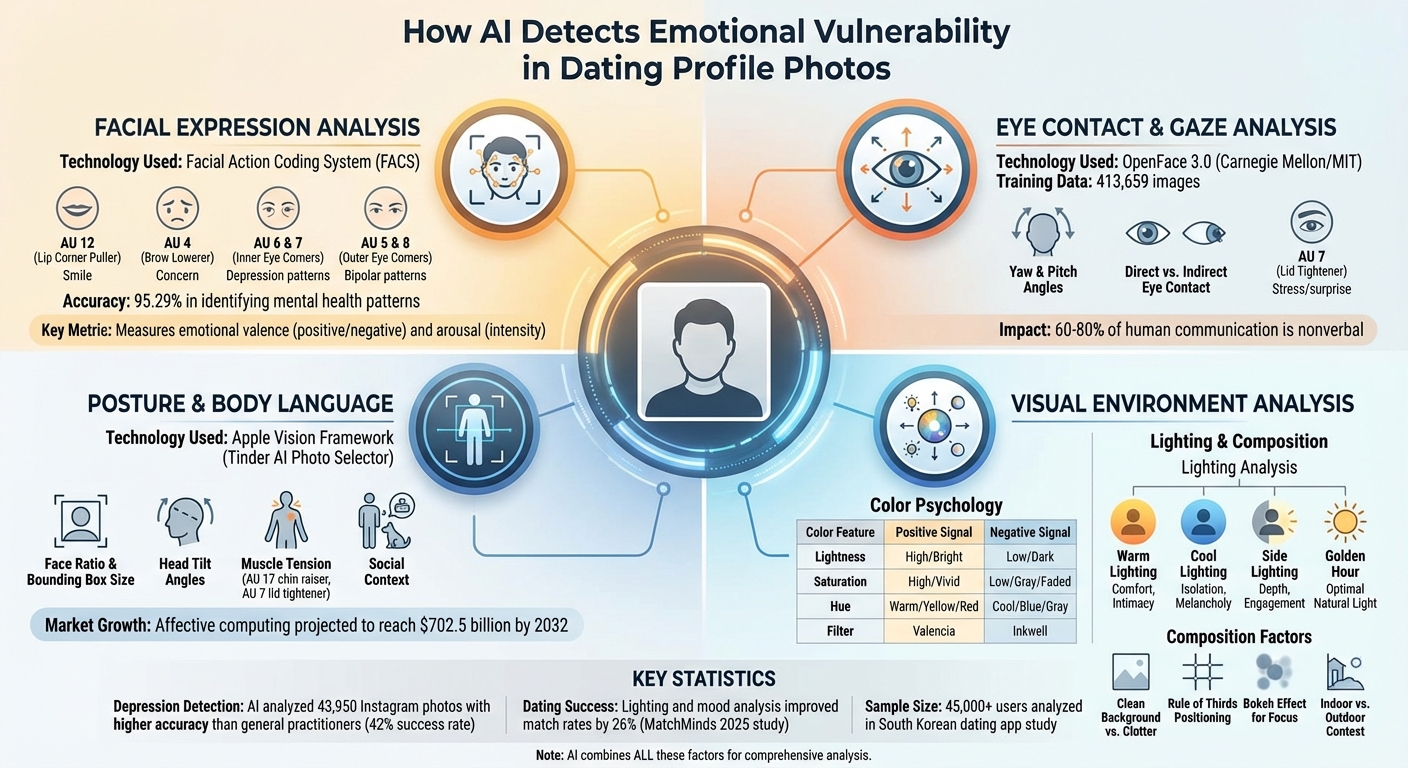
How AI Analyzes Dating Profile Photos: Key Detection Areas and Emotional Signals
Men Are Buying AI Dating Photos… Here’s Why It’s a Problem
sbb-itb-06ba92c
How AI Detects Emotional Vulnerability in Profile Photos
AI takes a closer look at your profile photo, breaking it down into data points to analyze subtle facial movements and head angles. By diving into these fine details, it uncovers emotional signals that might otherwise go unnoticed. This approach also lays the groundwork for understanding how AI interprets other nonverbal cues.
Facial Expression Recognition and Micro-Expressions
Modern AI uses the Facial Action Coding System (FACS) to decode facial movements into specific Action Units (AUs). Each AU corresponds to a unique muscle movement. For instance, AU 12 (lip corner puller) signals a smile, while AU 4 (brow lowerer) indicates concern [6].
AI doesn't stop there. It also measures emotional valence (how positive or negative an emotion is) and arousal (intensity of the emotion). Take the 2025 study on Emoface, for example. This AI model analyzed 353 participants and achieved a 95.29% accuracy rate in identifying Bipolar Disorder. Researchers found distinct patterns: individuals with Major Depressive Disorder showed more activity in the inner corners of their eyes (AUs 6 and 7), while those with Bipolar Disorder exhibited more movement in the outer corners (AUs 5 and 8) [7].
Micro-expression detection takes this a step further. These fleeting, involuntary facial movements last only fractions of a second, revealing authentic emotions that people might try to conceal.
"AI analysis of facial movements, incorporating emotional features, holds promise for developing rapid digital screening technologies... enhancing the accuracy of clinicians' diagnoses." - npj Mental Health Research [7]
Eye Contact and Gaze Analysis
Your eyes say a lot, and AI has become adept at interpreting these signals. Tools like OpenFace 3.0, developed by Carnegie Mellon University and MIT in 2025, analyze the yaw and pitch angles of each eye to determine whether you're making direct eye contact or looking elsewhere [9].
Eyes are critical for detecting emotions such as sadness or tension. Specific eye-related AUs, like AU 7 (lid tightener), can indicate heightened emotional states, including surprise or stress [6][10]. OpenFace 3.0 achieved impressive performance by training on extensive datasets, including 213,659 images from MPII Gaze and 200,000 images from Gaze360 [9].
"A slight shift in a person's eye gaze or tilt of the head, for example, are subtle facial behaviors that can substantially influence the social meaning being conveyed and interpreted during interactions." - Jiewen Hu et al., Carnegie Mellon University [9]
Since nonverbal cues account for 60–80% of human communication, AI prioritizes eye contact patterns as key indicators of emotional vulnerability. This focus on visual cues naturally extends to analyzing body language, adding depth to the emotional assessment.
Posture and Body Language Detection
AI doesn't just focus on your face - it evaluates your overall posture and presence within the photo. In 2025, Tinder's AI Photo Selector, created by engineer Thomas Yoon, introduced advanced posture analysis using Apple's Vision framework. It calculates the "face ratio" and bounding box size relative to the image frame to assess positioning and prominence [4].
This analysis helps pinpoint details like head tilt and muscle tension, which can signal stress or vulnerability [6]. For example, activity in the chin raiser (AU 17) or lid tightener (AU 7) suggests heightened emotional states. These insights contribute to refining your profile's authenticity and appeal.
AI also goes beyond individual posture by using multimodal models like InternVL-G to evaluate the broader context of your photo. It identifies whether you're interacting with others, pets, or objects that make you appear more approachable [2][5]. This comprehensive approach reflects the rapid growth of affective computing, a field projected to reach a market value of $702.5 billion by 2032 [8].
How Color, Lighting, and Composition Affect Emotional Signals
AI doesn’t just focus on your face - it evaluates the entire visual environment of your photo. Elements like color, lighting, and composition all work together to send emotional signals that algorithms can interpret with precision. Let’s break down how each of these factors shapes the emotional cues that AI picks up on.
Color Psychology in Profile Photos
AI assesses color using three primary dimensions: hue (the type of color), saturation (how vivid or muted it is), and brightness (how light or dark it appears) [11][13]. These metrics help machine learning models gauge what’s known as "Visual Valence" - emotional signals derived from the overall visual characteristics of an image rather than specific objects [12].
For example, a 2017 study analyzing 43,950 Instagram photos revealed that individuals with depression tended to post darker, grayer images and often used the "Inkwell" filter [13]. The AI model used in the study even outperformed general practitioners, who had a 42% success rate at diagnosing depression through traditional methods.
"Healthy individuals identified darker, grayer colors with negative mood, and generally preferred brighter, more vivid colors. By contrast, depressed individuals were found to prefer darker, grayer colors." - EPJ Data Science [13]
The proportion of colors in an image also plays a role in AI’s emotional predictions [12]. Researcher Jorge Alvarado, in a 2025 study, used the Openart-SDXL model to generate over 1,100 images based on specific emotions. He found that low chroma (muted colors) and low lightness (darker tones) consistently represented "sad" or "fearful" emotions, whereas "happy" emotions were linked to higher chroma and lightness levels [11].
| Color Feature | Positive Emotion Signal | Negative Emotion Signal |
|---|---|---|
| Lightness | High (Bright) | Low (Dark) |
| Saturation | High (Vivid) | Low (Gray/Faded) |
| Hue | Warm (Yellows/Reds) | Cool (Blues/Grays) |
| Filter Choice | Lightening (e.g., Valencia) | Monochromatic (e.g., Inkwell) |
To project emotional stability, opt for photos with warm tones and higher saturation. AI tends to associate cool tones like blue and gray with vulnerability or negative moods [11][13].
Lighting and Shadow Analysis
AI doesn’t just see light - it analyzes its quality, direction, and color temperature. Warm lighting (yellows and oranges) is often linked to feelings of comfort and intimacy, while cool lighting (blues) can evoke isolation or melancholy [14][15]. The direction of the light also plays a big role in how AI interprets emotional tone. For example:
- Frontal lighting can make an image feel flat and less dynamic.
- Side lighting adds depth and texture, creating a more engaging portrait.
- High-contrast lighting adds drama and mystery.
- Low-contrast lighting conveys calmness and harmony [14].
"The direction of light fundamentally alters the three-dimensional and emotional perception of any element in the image." - Human Academy [14]
A 2025 study by Junkyu Jang, Soonjae Kwon, and Sunghyuk Park analyzed over 45,000 users on a South Korean dating app. Their findings showed that while facial attractiveness influenced match rates, the overall mood created by lighting and other visual cues played a significant role in how photos were perceived [2].
For the best results, aim for side lighting during golden hour - the time just after sunrise or before sunset. This natural light is warm, soft, and directional, making it ideal for flattering portraits. Avoid under-lighting unless you’re intentionally going for a bold or unconventional look [14].
Photo Composition and Framing
AI doesn’t just analyze your face - it considers how you’re positioned in the frame and what’s happening in the background. Composition can convey intimacy or distance, depending on how the subject is framed [17]. Spatial context matters too; for instance, indoor settings often communicate joy more effectively than outdoor scenes [18].
Background distractions can dilute the emotional focus of an image. Using "bokeh" (a blurred background effect) can help direct attention to your expression [16][17]. Tight cropping on specific details can also enhance the emotional storytelling of your photo [16].
A clutter-free background is key to creating a strong emotional impact. A messy or chaotic setting can signal distraction, while a clean and simple backdrop keeps the focus on you. Using the "Rule of Thirds" - placing key elements along an imaginary grid - creates visual balance that AI often interprets as more emotionally engaging [16].
Every element in your photo contributes to the overall emotional impression. By carefully considering color, lighting, and composition, you can craft images that send the emotional signals you want to project.
Ethics of Using AI to Detect Emotions in Dating
While AI can enhance your dating profile by analyzing emotional nuances, its use raises serious ethical questions about privacy, consent, and potential exploitation. The same tools that help you select better profile pictures could also be misused to monitor or manipulate users.
Balancing Technology with Privacy
One major concern is that your face can reveal emotional data without your explicit consent. Researcher Elaine Sedenberg explains:
"Emotion AI places itself as an algorithmic lens on our digital artifacts and real-time interactions, creating the illusion of a new, objective class of data: our emotional and mental states" [19].
To address privacy concerns, some systems now focus on on-device processing, analyzing images directly on your smartphone instead of sending them to external servers. This method offers more control over your emotional data but isn't foolproof. Regulations like the EU's GDPR and US FTC guidelines provide some protections, yet they often fall short when it comes to "emotion data" specifically [19].
For instance, in December 2023, the FTC reached a settlement with Rite Aid after its facial recognition system unfairly targeted and misidentified individuals, particularly people of color, as shoplifters. The settlement banned Rite Aid from using the technology for five years and required stricter consumer notifications and bias testing [20][22].
To safeguard your data, platforms should rely on explicit consent mechanisms and prioritize on-device processing. These measures, while helpful, don't entirely eliminate the risk of misuse, as explored below.
Preventing Manipulation Through AI Insights
The misuse of emotional data extends beyond privacy, opening doors to exploitation. Emotional vulnerabilities can become targets for scams and manipulation. In June 2023, the FBI issued a public alert (Alert Number I-060523-PSA) about a rise in sextortion schemes. Criminals used AI to transform innocent social media photos into explicit content for blackmail [24].
Thousands of AI-generated images have been found on dark web forums, highlighting the dangers of this technology [24]. Rachel Fletcher, a PhD researcher at the University of Huddersfield, cautions:
"Messaging surrounding the use of reverse image search machines to catch out catfish perpetrators appears outdated given increased use of deepfakes" [24].
AI now enables the creation of entirely realistic fake personas, making it harder to trace or verify identities.
To combat these risks, platforms must implement bias mitigation and involve human oversight. A 2019 study of Microsoft's FaceDetect system revealed a 0% error rate for light-skinned male subjects but a 20.8% error rate for dark-skinned female subjects [22]. Such biases can lead to unfair outcomes or misinterpretations of emotional cues across different demographics [20][21][22].
Attorney Lena Kempe, founder of LK Law Firm, emphasizes:
"Emotional AI, if not operated and supervised properly, can cause severe harm to individuals and subject companies to substantial legal risks" [20].
The most responsible platforms will allow users to challenge AI-driven decisions, provide real-time feedback on emotional data analysis, and conduct regular audits to identify and address risks [20][23].
Ultimately, AI should empower you to represent your genuine self, not exploit your vulnerabilities. Look for platforms that prioritize transparency, keep data processing on your device, and let you control when and how your emotional data is analyzed.
Conclusion: Using AI to Improve Your Dating Profile
AI has reached a point where it can interpret subtle emotional cues in dating photos. By analyzing micro-expressions and traits like trustworthiness, these tools can evaluate details that most people might overlook. From facial expressions and mood to social signals, AI predicts which photos are likely to attract the most matches. This gives users actionable insights to refine their profiles and improve their chances of dating success.
How AI Can Help You Stand Out
AI tools can pinpoint your most appealing photos by examining facial expressions, composition, and emotional resonance. For instance, Dating Photo AI helps create profile pictures that genuinely represent you, enhancing your match potential while staying true to who you are.
The key is finding a balance between technical optimization and staying authentic. As Kelly Shue, Amman Mineral Professor of Finance at Yale SOM, puts it:
"I do think the machine is picking up on many things that are too subtle to be consistently picked up by the human eye" [25].
AI can highlight the best angles, expressions, and setups that showcase traits like trustworthiness and approachability - without making you look overly polished or artificial. These advancements are setting the stage for even more exciting applications of AI in online dating.
The Future of AI in Online Dating
AI's ability to read subtle emotional signals is just the beginning. The next step involves real-time analysis and interactive AI tools. For example, in 2025, the Australian startup MatchMinds introduced mood tracking during live video speed dates. By analyzing emotional engagement during conversations, they improved match success rates by 26% [1]. Whitney Wolfe Herd, founder of Bumble, envisions a future where:
"AI bots could interact with each other on behalf of users to determine compatibility before a human-to-human match is made" [26].
The focus is shifting from simply predicting facial beauty to evaluating overall impressions, including intelligence, reliability, and social value [3]. Tools like Photofeeler-D3, which match the accuracy of 15 human voters in predicting personality traits [27], demonstrate how far this technology has come - and how much it can help you present your most authentic and appealing self.
FAQs
How does AI protect your privacy when analyzing emotions in profile pictures?
AI protects your privacy by handling emotional cues directly on your device. No images are sent to external servers. When you upload a profile picture, the system processes facial features and expressions locally. Once the analysis is complete, both the image and any related data are immediately deleted. In short, your photo never leaves your device.
To keep your data secure, AI systems adhere to privacy-by-design principles. These include collecting minimal data, encrypting any temporary information, and avoiding long-term storage. Such precautions align with U.S. data protection standards and address concerns about the potential misuse of biometric data.
What ethical issues arise from AI analyzing emotions in dating profile photos?
AI systems that assess emotions in profile pictures come with a host of ethical challenges. For starters, they turn deeply personal emotional expressions into data, often used for profit. Many times, this happens without users fully understanding or consenting to how their information is being used. This data could be leveraged to nudge users toward certain matches or encourage spending, blurring the line between helpful guidance and outright manipulation.
Another concern is the potential misuse of this technology by bad actors. Emotion analysis powered by AI could be weaponized to create fake profiles or chatbots designed to trick users into revealing personal details. In more severe cases, this misuse could escalate to stalking or even blackmail, posing serious safety risks for users.
On top of that, emotion-recognition models are not immune to bias. If these systems are trained on datasets that reflect stereotypes - whether cultural or gender-based - they might misinterpret emotions or unfairly disadvantage specific groups. These issues underscore the need for transparency, strict data policies, and regular audits to ensure the ethical application of emotional AI in dating platforms.
How can you use AI to enhance your dating profile while staying authentic?
Using AI to refine your dating profile is about striking the right mix of polish and staying true to who you are. AI tools can help you pick photos that showcase your best side - like a confident smile or a warm, approachable vibe - while also improving technical details like lighting and composition. The goal? To make your profile visually appealing without straying from your natural look.
It's important to keep things real. Avoid heavy editing or drastic changes to your photos. Small tweaks, like adjusting the lighting or cropping, are completely fine. But altering facial features or backgrounds can make your profile feel less authentic. Tools like Dating Photo AI can help by enhancing the quality of your existing photos without changing what makes you, you. This way, you can catch someone’s attention while staying genuine.