

Eye Contact vs. No Eye Contact: Which Works Better?
When it comes to dating profile photos, eye contact is the clear winner. Research shows that direct eye contact increases your chances of being chosen by 1.72 times and boosts feelings of trust and connection. It activates the brain's reward center, making you appear more approachable and confident. On the other hand, photos without eye contact can feel more natural and mysterious but may lower likability and perceived competence.
Key Takeaways:
- Eye Contact: Creates trust, increases attractiveness, and triples match likelihood during mutual gaze.
- No Eye Contact: Adds intrigue but reduces trust and likability; better for secondary photos.
- Best Practices: Look slightly below the camera, avoid sunglasses, and use a slight squint ("squinch") for confidence.
For the best results, use direct eye contact in your main photo and reserve candid, off-camera shots for secondary images. Eye contact plays a powerful role in making a lasting first impression.
Eye Contact in Dating Profile Photos
The Psychological Impact of Eye Contact
When someone looks directly into your eyes in a photo, it does more than just grab your attention - it actually activates the brain's reward center. Specifically, it boosts activity in the ventral striatum, the part of the brain tied to dopamine release and feelings of reward [7]. And when the person making eye contact happens to be attractive, this effect is even stronger, creating a sense of connection.
"The perceived attractiveness of an unfamiliar face increases brain activity in the ventral striatum of the viewer when meeting the person's eye." - Knut K. W. Kampe, Institute of Cognitive Neuroscience [7]
Eye contact also sparks emotional mimicry [8], helping viewers feel understood and easing any uncertainty they might have [1]. According to Uncertainty Reduction Theory, a direct gaze boosts nonverbal expressiveness, creating an instant sense of intimacy - even through a screen. The eyes serve a dual purpose: they send signals of interest and confidence while also receiving attention from others. Being looked at can trigger positive arousal and evoke pleasant emotions [4]. This makes eye contact a powerful social tool, communicating approachability, self-assurance, and interest - qualities that are crucial when someone is deciding whether to swipe right.
These psychological and neurological responses set the stage for the real-world impact of eye contact in dating profiles.
Benefits of Eye Contact in Profile Photos
Photos with direct eye contact are like the front door to your dating profile - they invite people in. By tapping into these neurological effects, such photos encourage viewers to explore your profile further [3].
Research on speed dating highlights the importance of mutual gaze: when eye contact was reciprocated, the likelihood of a positive match tripled for every additional minute of eye contact [4]. Direct eye contact is also linked to higher ratings of likability, trustworthiness, and charisma [4] [8], making you seem more genuine and approachable.
Here’s a simple tip: when taking your profile photo, look slightly below the camera lens instead of directly into it [2]. This creates a more natural and engaging gaze on smartphone screens, where most dating profiles are viewed. And one more thing - ditch the sunglasses. Covering your eyes breaks the sense of connection and can make you come across as less trustworthy or even uninterested [8].
No Eye Contact in Dating Profile Photos
The Appeal of No Eye Contact Photos
Photos without direct eye contact can feel more natural and unposed. A candid moment - like a laugh caught mid-air or a casual glance away - can come across as genuine, drawing people in with an air of spontaneity and approachability [10]. There's also a sense of intrigue that comes with an averted gaze, which some interpret as mysterious or even sophisticated [6][12]. Interestingly, studies suggest that when someone isn't looking directly at the camera, it reduces activity in the brain's reward center [7]. This can make the image feel less intense or socially demanding for the viewer, creating a more relaxed impression.
Another advantage? No eye contact can stir curiosity. When someone can't make direct eye contact with you through a photo, it adds an element of uncertainty that might make them want to learn more. Pairing these types of shots with images that showcase your hobbies, travel adventures, or day-to-day personality can encourage viewers to dig deeper into your profile.
But while these qualities can be appealing, there are some notable downsides to consider.
Drawbacks of No Eye Contact in Profile Photos
Choosing photos without eye contact isn't without its risks. Research indicates that obscuring your eyes - whether by looking away, wearing sunglasses, or even through shadows - can lower your likability score by an average of -0.36 [6]. It also impacts how others perceive your competence (-0.29) and influence (-0.31) [6].
Beyond the numbers, the absence of eye contact can sometimes send the wrong message. It might make you seem distant or uninterested, qualities that could come across as unapproachable to potential matches [12]. While a little mystery can be intriguing, too much of it might make you seem emotionally unavailable. For this reason, photos without direct eye contact are better suited as secondary images - ones that highlight your lifestyle or interests - rather than your main profile picture [11][12].
These insights set the stage for a closer look at how different photo choices impact dating profiles in the next section.
What Is the Best Eye Contact for Online Dating Photos?
sbb-itb-06ba92c
Research and Data Comparison
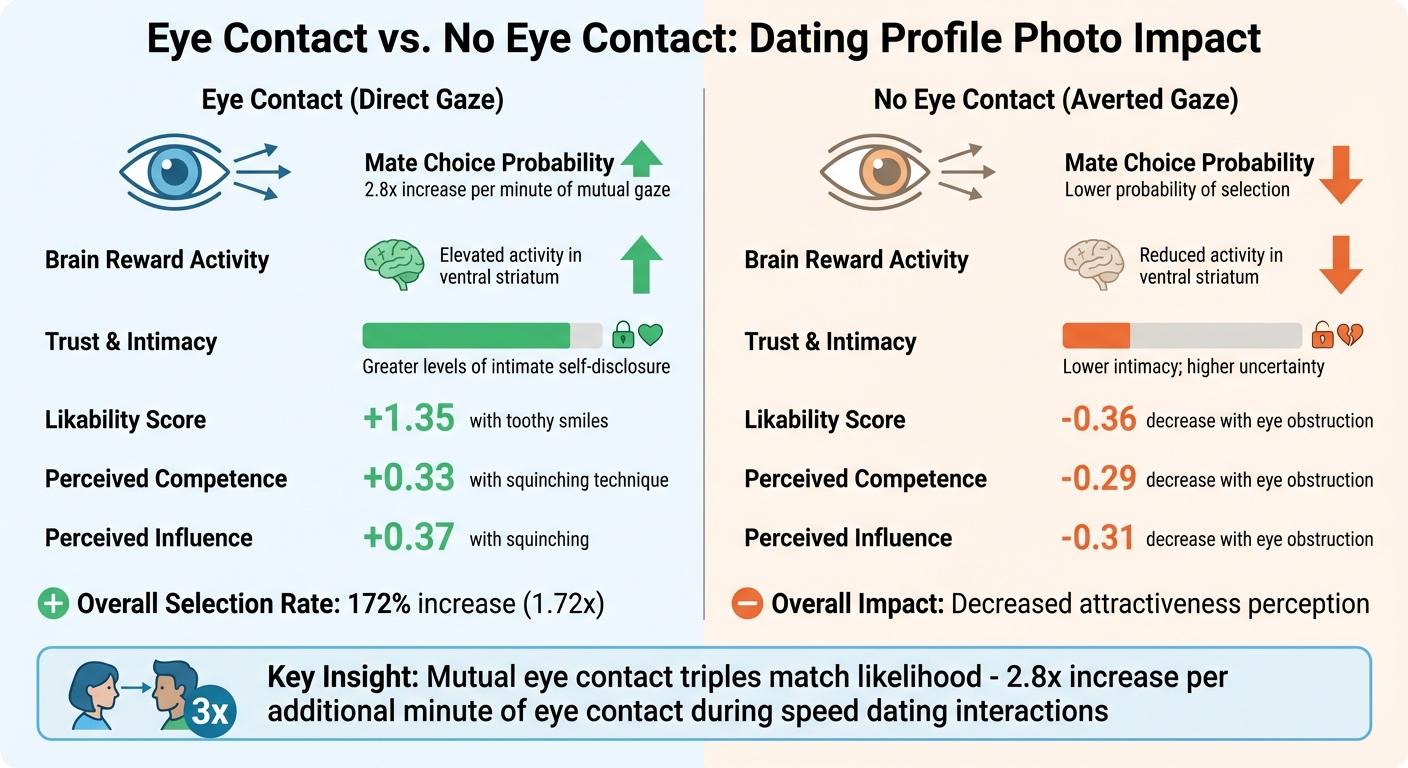
Eye Contact vs No Eye Contact in Dating Profile Photos: Research-Backed Comparison
Key Metrics for Comparison
When studying the role of eye contact in dating, researchers zeroed in on three main areas: the likelihood of choosing a mate, brain activity tied to rewards, and trust perception. A 2024 study published in the Archives of Sexual Behavior followed 60 participants across 240 speed-dates using dual mobile eye-tracking. The results? Mutual eye contact was a standout predictor of whether someone wanted to see their date again - regardless of physical appearance. For every additional minute of mutual eye contact during a 5-minute interaction, the odds of a positive mate choice jumped by 2.8 times. Even just receiving eye contact from a partner increased the chances by 1.72 times per minute. For men specifically, this figure climbed to 1.94 times per minute [4].
Brain imaging studies back up these findings. Research from the Institute of Cognitive Neuroscience revealed that when individuals saw an attractive face making direct eye contact, activity in the ventral striatum - a brain area tied to reward prediction and dopamine release - spiked. Conversely, when the gaze was averted, this activity dropped. Knut K. W. Kampe, a researcher involved in the study, explained:
"The perceived attractiveness of an unfamiliar face increases brain activity in the ventral striatum of the viewer when meeting the person's eye, and decreases activity when eye gaze is directed away."
The table below provides a snapshot of these findings.
Comparison Table of Results
| Metric | Eye Contact (Direct Gaze) | No Eye Contact (Averted Gaze) |
|---|---|---|
| Mate Choice Probability | 2.8x increase per minute of mutual gaze [4] | Lower probability of selection [4] |
| Brain Reward Activity | Elevated activity in ventral striatum [7] | Reduced activity in ventral striatum [7] |
| Trust & Intimacy | Greater levels of intimate self-disclosure [1] | Lower intimacy; higher uncertainty [1] |
| Likability Score | Linked to higher charisma [4] | -0.36 decrease (with eye obstruction) [6] |
| Perceived Competence | Higher ratings (+0.33 with squinching) [6] | -0.29 decrease (with eye obstruction) [6] |
Across all metrics, eye contact consistently outperformed averted gaze. What’s fascinating is the gap between perception and reality: while participants believed they maintained eye contact for about 60% of the time, actual measurements revealed it was only 8.25%. Even brief glances, it seems, carry a lot of weight [4].
Pros and Cons Comparison
Pros and Cons Table
The table below provides a straightforward comparison of the advantages and disadvantages of photos with and without eye contact, based on the research metrics discussed earlier.
Photos with eye contact can create a sense of trust by triggering oxytocin and activating reward centers in the brain [5][7]. However, overly wide eyes might signal vulnerability, and combining direct eye contact with a laughing smile could enhance likability but reduce perceived competence [6].
On the other hand, photos without eye contact often evoke a sense of mystery but can lower trustworthiness. An averted gaze tends to decrease brain reward activity and increase uncertainty for the viewer [7][1]. Additionally, obstructing the eyes - whether through sunglasses, hair, or shadows - reduces both likability (by 0.36 points) and perceived competence (by 0.29 points) [6].
Here's a side-by-side breakdown of these findings:
| Factor | Eye Contact | No Eye Contact |
|---|---|---|
| Trust & Connection | High: conveys openness [5] | Low: seen as less trustworthy [9] |
| Perceived Attractiveness | Significantly improved [7] | Decreased [7] |
| Likability | High, especially with toothy smiles (+1.35) [6] | Lower: sunglasses reduce by 0.36 [6] |
| Competence & Influence | Higher with "squinching" (+0.33 competence, +0.37 influence) [6] | Lower: eye obstruction drops competence by 0.29 and influence by 0.31 [6] |
| Intimacy Level | Higher: reduces uncertainty [1] | Lower: creates more impersonal interactions [1] |
| Mate Choice Probability | Triples with mutual gaze [4] | No significant effect on mate selection [4] |
One effective technique to balance these dynamics is the "squinch" - a slight squinting of the lower eyelids. This subtle adjustment projects confidence without appearing vulnerable, boosting perceived competence by +0.33 and influence by +0.37 [6].
Which Approach Works Better for Dating Profiles
Practical Tips for Profile Photos
Turning research into practical advice, here are some strategies to make your dating profile photos more engaging and effective.
Start with your primary profile photo: eye contact is key. A direct gaze can trigger the release of oxytocin and activate reward centers in the brain, creating an instant sense of connection with viewers [5][7]. In fact, studies show that just one extra minute of mutual eye contact during an initial interaction can increase your chances of being selected as a potential match by a whopping 300% [4].
For the best results, aim your gaze slightly below the camera lens instead of directly into it. This small tweak creates a more natural perception of eye contact on smartphone screens [2]. Pair this with a slight "squinch" (a subtle narrowing of the eyes) to exude confidence without coming across as overly intense [6]. And skip the sunglasses in your main photo - they block the all-important eye connection.
When it comes to secondary photos showcasing your hobbies or activities, looking away from the camera can add variety and a sense of context. Just make sure your torso is still facing the camera to keep the image engaging. Women generally see better results with full smiles and direct eye contact, while men might benefit from trying a neutral expression with a slightly averted gaze [5].
If you're unsure about how to get the perfect shot, tools like Dating Photo AI can help you create high-quality images that highlight eye contact and showcase your personality - helping you attract more matches while staying true to yourself.
Final Verdict: Eye Contact or No Eye Contact?
The data speaks loud and clear: eye contact wins. Eye contact with a potential match increases the likelihood of a positive impression by 172% [4]. Since viewers form their first impression within just 100 milliseconds of seeing your photo [5], making eye contact in your main image is a critical step toward standing out.
FAQs
Why does eye contact matter in dating profile photos?
Eye contact is a game-changer when it comes to making a strong first impression on dating apps. A photo where the subject appears to be looking directly at the viewer can convey confidence, warmth, and sincerity - qualities that people naturally find attractive and trustworthy.
Interestingly, research highlights that direct eye contact activates the brain's reward centers, making the person in the image seem more appealing. Even small tweaks, like gazing just slightly below the camera lens, can create a more natural and inviting look. Dating Photo AI leverages cutting-edge technology to fine-tune eye positioning in profile pictures, helping users stand out and form meaningful connections that could boost their match rates significantly.
What is a 'squinch,' and how can it improve profile photos?
A squinch is a subtle technique where you slightly lower your gaze, focusing just below the camera lens instead of directly into it. This small adjustment creates the illusion of natural eye contact, making your expression feel more genuine and engaging. It’s a simple trick that can convey confidence and approachability - qualities that are often associated with increased trust and likability, especially in online dating.
Studies have found that profile photos with a sense of eye contact tend to draw more attention, resulting in more swipes, messages, and matches. Using advanced AI technology, Dating Photo AI can refine your gaze in photos to perfect the squinch, helping you project a confident and inviting demeanor that could make all the difference in your dating profile.
How can photos without eye contact work well in dating profiles?
Photos without direct eye contact can still leave a lasting impression by focusing on other visual elements that make them appealing. While looking straight into the camera often enhances connection and charm, a well-crafted "look-away" pose can exude confidence and a touch of mystery. Pair this with a natural smile, clear lighting, and a clean, visually engaging background to grab attention.
Here are some tips to make these photos work:
- Position the camera slightly above eye level and have the subject look just below the lens for a subtle yet confident feel.
- Use high-quality, sharp images with proper lighting to ensure the photo stands out.
- Add a personal touch by including an activity or prop, like holding a coffee cup or playing an instrument, to showcase personality and spark curiosity.
To complement the photo, pair it with a playful and concise bio that highlights your personality. When done thoughtfully, photos without direct eye contact can feel approachable, authentic, and inviting, making them just as effective in creating connections.