
Top Scams Targeting Dating App Users
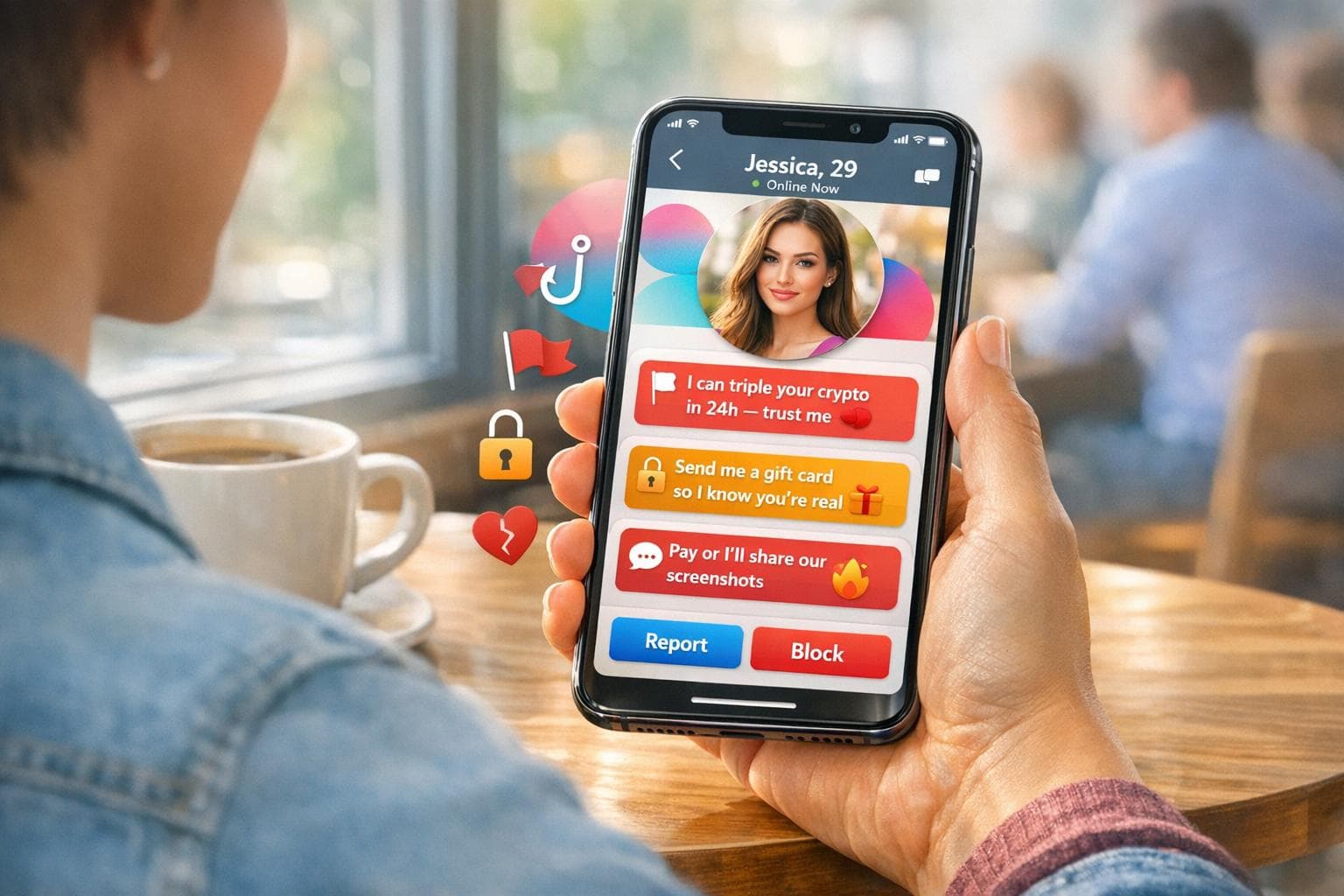
Dating apps are now a prime target for scammers, costing Americans billions annually. Scammers use AI to create fake profiles, manipulate emotions, and steal money. Here’s a quick breakdown of the top scams and how to protect yourself:
- Romance Investment Scams: Scammers build trust, then push fake cryptocurrency investments. Victims often lose thousands.
- Fake Profiles & Catfishing: AI-generated photos and chatbots make spotting fake accounts harder than ever.
- Sextortion Scams: Scammers use explicit photos to blackmail victims, often escalating emotional and financial damage.
- Emergency Money Requests: Fraudsters fabricate crises to solicit funds, preying on victims’ empathy.
Key Stats:
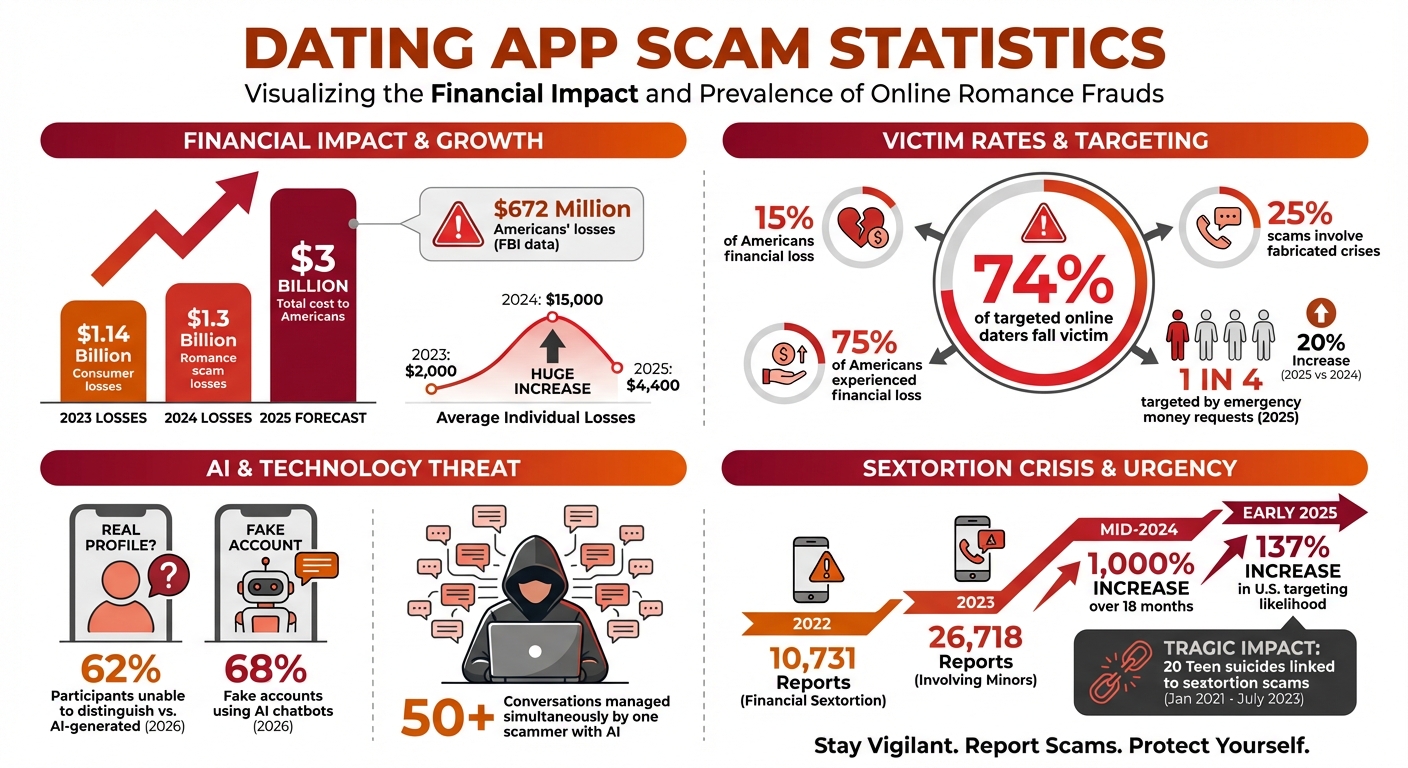
- Romance scams cost Americans $3 billion in 2025.
- 74% of targeted online daters fall victim.
- Average losses per victim: $4,400.
How to Stay Safe:
- Verify identities with live video calls.
- Be cautious of investment advice or financial requests.
- Avoid sharing sensitive content online.
Dating apps can be risky, but staying alert and following these tips can help you avoid scams.
Dating App Scam Statistics and Financial Impact 2024-2026
Avoid This NEW Online Dating Scam Using AI
sbb-itb-06ba92c
Romance Investment Scams
Romance investment scams often follow a deceptive strategy known as "pig butchering." Here, scammers spend weeks - or even months - building emotional connections with their victims before steering them toward financial ruin. Instead of outright asking for money, these scammers pose as financial experts, offering so-called "insider tips" and showcasing fake screenshots of their own supposed investment success.
How Scammers Operate
These scams are calculated and emotionally manipulative. Scammers use tactics like love bombing - flooding their targets with affection, constant messages, and declarations of being soulmates - to create emotional dependency. They share personal stories and maintain daily contact to build trust.
Once trust is established, scammers encourage moving the conversation to encrypted messaging apps like WhatsApp, Telegram, or Signal, sidestepping the safety measures of dating platforms. They then introduce cryptocurrency investment opportunities, often creating a sense of urgency by promising "guaranteed" returns or claiming an imminent price surge.
A real-world example highlights the devastating impact of these scams. In February 2026, Jackie Crenshaw from Connecticut lost nearly $1 million after meeting a scammer on the dating app BLK. Over two months, the scammer groomed her through daily communication and convinced her to invest in cryptocurrency. They even allowed her to make a small withdrawal initially, which built her confidence. Tragically, she ended up transferring her entire 401(k) savings before the scammer vanished [6]. Cybersecurity expert Adam Levin explains the process:
They get you involved, and they help you open an account. Oftentimes it's on a legitimate site. You make some money. They even let you take the money out, but then they kind of wet your whistle. You get really excited about it, and then all you want to do is do more and more and more [6].
Recognizing these tactics early can make all the difference in avoiding such scams.
Prevention Tips
To protect yourself, treat any investment advice from an online match as a major warning sign. If someone you've never met in person starts talking about cryptocurrency, trading platforms, or promises of "guaranteed" returns, block them immediately. Keeping conversations on the dating app until meeting in person is another key precaution. Be wary of requests to switch to apps like WhatsApp or Telegram, as this is often a red flag.
Consider arranging an early live video call to verify their identity. Ask them to perform a spontaneous action, like waving or turning their head, to ensure they're genuine. Scammers often struggle to keep their stories straight when juggling multiple victims. Above all, never send money or make investments based solely on advice from someone you've only met online.
Fake Profiles and Catfishing Scams
Catfishing has become much more sophisticated than simple photo theft. Scammers now use AI-generated synthetic identities - complete with hyper-realistic faces that don’t belong to any real person. These fabricated profiles are so convincing that traditional reverse image searches often fail to detect them [8]. A 2026 study found that 62% of participants couldn’t distinguish between real and AI-generated dating profiles when shown a mix of both [4]. This evolution in scamming tactics makes verification increasingly challenging, requiring more advanced detection strategies.
The financial toll is massive. In 2024, romance scams cost victims a jaw-dropping $1.3 billion, with individual losses averaging about $15,000 [9]. By 2026, 68% of fake dating app accounts were using AI chatbots powered by advanced language models, enabling a single scammer to juggle over 50 conversations at once without breaking character [8]. Paul Tucker, Chief Information Security and Privacy Officer at BOK Financial, highlights the issue:
AI has fundamentally changed the landscape of online fraud by removing many of the traditional warning signs that once helped people identify scams [4].
Identifying Fake Profiles
Spotting fake profiles starts with scrutinizing their photos. Profiles featuring only professionally shot, perfectly lit images are a major warning sign. Real dating profiles usually include a mix of casual selfies, group photos, and tagged pictures from friends - reflecting the messy, unpolished reality of everyday life. While scammers might steal individual photos, they often fail to replicate the organic social interactions that create a believable online presence [7].
Pay attention to how they communicate. AI-powered scammers often respond instantly, display exaggerated empathy, and use flawless grammar that can come off as overly formal or even poetic [8]. They may also contradict themselves on basic details like their job or location, especially when juggling multiple victims at once [7]. Recognizing these signs can help you stay alert during conversations.
Avoiding Catfishing Traps
To steer clear of catfishing traps, act quickly. Request a live video call within the first week of matching. If someone repeatedly declines with excuses like "my camera’s broken", "I have bad internet", or "I’m on a military deployment", consider it a major red flag [7]. Amir Sharifian, Founder of PeopleFinder.app, puts it bluntly:
A catfish cannot video call you because they do not look like the person in the photos. Every excuse they give... is a stall tactic [7].
Even video calls aren’t foolproof, thanks to advanced deepfake technology. Some scammers now use real-time deepfakes to mimic an attractive persona’s face and voice during live calls [8]. To counter this, ask for spontaneous movements - like a quick wave or a 90-degree head turn. Deepfake masks often glitch or distort during these actions, revealing their artificial nature [8].
For extra protection, rely on AI face search tools that analyze facial geometry instead of pixel-perfect matches. Traditional reverse image searches can’t keep up with AI-generated or altered photos, but these specialized tools can track where a face appears online, even under different aliases [7]. Lastly, check their social media for tagged photos from friends and family - something fake profiles rarely include [7].
Sextortion and Blackmail Scams
Sextortion scams stand out among dating app scams for their deeply personal and often devastating impact. These schemes rely on emotional manipulation, moving quickly to create a false sense of trust. Scammers often use tactics like "love bombing", where they overwhelm victims with declarations of affection and connection. Once trust is established, they push to move the conversation off the dating platform, eliminating the safety features that apps provide.
The numbers are alarming. In 2023, the National Center for Missing and Exploited Children received 26,718 reports of financial sextortion involving minors - more than double the 10,731 cases reported in 2022 [11]. By mid-2024, incidents had surged by 1,000% over just 18 months [11]. In early 2025, the likelihood of being targeted in the U.S. increased by 137% [12]. Tragically, between January 2021 and July 2023, the FBI linked at least 20 teen suicides to the emotional toll of these scams [11].
Common Sextortion Tactics
These scams often begin with scammers sending explicit photos, which are frequently stolen or generated using AI, to create a false sense of mutual vulnerability. Victims are then pressured to share their own intimate photos or videos. Leeza Garber, a Cybersecurity and Privacy Attorney, highlights how AI has made these scams even more dangerous:
Bad actors take benign images that people post to social media, dating apps, blogs... and they use AI machine learning and deep fake applications to turn them into sexualized images and potentially even videos as well without any consent from the victim [10].
Once scammers obtain compromising material, their tone shifts dramatically. They threaten to release the content unless payment is made, often demanding cryptocurrency or gift cards. Wendy Zamora from Malwarebytes Labs describes a chilling example:
Savannah morphed from vixen to vice, threatening Charlie with posting his nude picture all over social media - unless he sent $500 [11].
Paying doesn’t guarantee safety. Scammers often continue demanding money and may release the images anyway. This cycle of threats and extortion highlights the need for quick, decisive action.
How to Stay Safe
To protect yourself, follow these essential precautions: Avoid sharing intimate content with anyone you haven’t met in person. Always assume that explicit content could be misused. If someone pressures you to share sensitive material, disengage immediately - this urgency is a deliberate tactic to cloud your judgment.
If you’re targeted, block the scammer and do not pay. Before blocking, document all communications as evidence. Report the incident to the FBI's Internet Crime Complaint Center at IC3.gov or the NCMEC's CyberTipline. Victims can also utilize services like "Take It Down" or "Project Arachnid" to help remove explicit images from online platforms. Michal Salat, Threat Intelligence Director at Avast, explains the psychological pressure these scams create:
Our analysis reveals that sextortion victims frequently receive threatening messages claiming access to their private videos and images. Fear of exposure, especially when personal details appear accurate, often pressures victims into complying with ransom demands [12].
Emergency Money Request Scams
Emergency money request scams prey on people's natural instinct to help those in crisis. Scammers weave intricate stories designed to tug at heartstrings and push victims into making hasty financial decisions.
The scale of this issue is alarming. In 2023 alone, consumers lost $1.14 billion to romance scams, with the average individual loss sitting at around $2,000 [3]. By early 2025, these incidents had risen by 20% compared to 2024 [3]. Notably, about 25% of these scams involve fabricated crises such as medical emergencies, legal troubles, or other dire situations. In 2025, one in four online daters reported being targeted by such schemes [2].
Recognizing Crisis Scenarios
Scammers often follow a predictable formula when crafting their emergency stories. Here are some common scenarios to watch out for:
- Medical Emergencies: Fraudsters may claim they or a loved one urgently need surgery or hospitalization but can't afford the cost [13].
- Travel Disasters: They might say they've been robbed while traveling, lost their passport, or need money for a plane ticket to visit you [3]. Some even pose as offshore workers on oil rigs or cargo ships, citing poor banking access as the reason they can’t handle their own finances. This specific story is used by about 6% of romance scammers [2].
- Legal Troubles: Scammers might claim they are in jail and need bail money or are being held by corrupt officials abroad who require payment for their release [2]. Military imposters often ask for funds to cover "leave request fees", while others use the "gift trap", saying a luxury item they sent is stuck in customs and requires additional fees [2].
FBI Special Agent in Charge Wayne A. Jacobs offers a clear warning:
Requests for money, cryptocurrency, or your personal information are clear warning signs of a scam, not a legitimate relationship. If you encounter any of these red flags... end all communication immediately. [15]
These fabricated crises are designed to create panic, pushing victims to act quickly without considering the red flags.
Why You Should Never Send Money
One rule stands above all: never send money to someone you’ve only met online, no matter how convincing their story might be. Scammers often demand payments through irreversible methods like wire transfers, cryptocurrency, or gift cards, ensuring that once the money is sent, it’s gone for good [15].
Sending money even once can make you a repeat target. Scammers will keep coming back, exploiting your generosity. In 2024, Americans collectively lost over $672 million to romance scams, with more than 17,000 complaints reported [15]. Around 15% of Americans have experienced financial loss from online dating scams [5].
The emergence of AI in 2026 has made spotting scams even harder. Fraudsters now use hyper-realistic AI-generated photos, deepfake video calls, and voice cloning to build trust. Even video calls, once a reliable way to verify someone’s identity, can now be faked using advanced masking technologies [15].
FBI Special Agent in Charge Ted E. Docks stresses the importance of slowing down:
Fraudsters are lurking online claiming to be looking for love when they're really just looking to loot your bank account. We're urging everyone to take a beat. [15]
Another common tactic is demanding secrecy. Scammers often insist you keep their requests private, isolating you from friends or family who might otherwise recognize the scam [14]. This deliberate isolation helps them avoid scrutiny and maintain control.
If someone you’ve never met in person asks for money, the best course of action is to block them immediately. Report their profile to the dating app and file a complaint with the FBI’s Internet Crime Complaint Center at IC3.gov. Before making any financial decisions, consult trusted friends or family members to verify the legitimacy of the claims.
These scams highlight the importance of staying cautious and vigilant in all online interactions.
Using Authentic Photos to Improve Profile Safety
The Role of High-Quality Photos
With scams on the rise, using authentic photos has become a crucial part of keeping your profile secure. Profile pictures do more than just put a face to your name - they help build trust and differentiate you from potential scammers. By 2026, many platforms have started flagging photos that seem overly edited or inconsistent. Using natural, authentic images can help you pass these automated checks and reassure potential matches that you're genuine.
Real people post a mix of content - a blurry selfie in their kitchen, a decent photo at a friend's wedding, an awkward group shot from a barbecue. That variety is what authentic profiles look like [7].
Scammers, on the other hand, tend to rely on overly polished, staged images that look like they belong in a magazine spread.
Authentic photos also ensure consistency during video calls, which helps reduce the chances of deepfake-related glitches [8]. This kind of consistency can immediately build trust with matches who are becoming more cautious about AI-generated profiles.
How Dating Photo AI Can Help
If you’re struggling to create authentic-looking photos, AI tools like Dating Photo AI can make the process easier. This platform uses advanced technology to generate realistic, high-quality images that reflect your true appearance. By uploading your existing photos, you can get professional-looking pictures designed to attract genuine matches.
Dating Photo AI solves a common problem: creating polished photos that don’t look overly edited or fake. The tool focuses on natural textures and lighting, producing images that pass platform checks and feel genuinely human. With flexible plans to match your needs, it’s a practical way to build a profile that earns trust and stands out in the right way.
Conclusion
By 2026, dating app scams have evolved into a sophisticated mix of AI-driven tactics, exploiting emotions and trust through methods like romance investments, AI-powered catfishing, and sextortion. The financial toll is massive - romance scams caused $1.3 billion in losses in 2024, with the average victim losing roughly $15,000 [9]. However, the emotional damage often surpasses the financial loss. As Tony Jan, Professor of Information Technology at Torrens University Australia, explains:
Romance scams are among the most emotionally damaging forms of cyber crime because they combine carefully manufactured intimacy with financial theft – the scammers go after your heart, and then your wallet [1].
Protecting yourself starts with cautious verification. Early live video calls, staying on the app until meeting in person, and treating mentions of cryptocurrency or emergency money requests as warning signs can help you stay safe. Taking your time puts you in control and minimizes a scammer's ability to manipulate you.
Equally important is creating a genuine profile. High-quality, natural photos not only pass verification checks but also build trust. Tools like Dating Photo AI, which generates realistic images from your uploads, can enhance both your safety and your chances of success on dating apps.
While the dating world has shifted, you can still navigate it safely. Stay alert, trust your instincts, and prioritize verification over rushing - your safety and peace of mind are worth it.
FAQs
What are the biggest red flags of a romance investment scam?
Romance investment scams often rely on deception, using fake profiles, AI-generated images, or even scripted conversations to lure victims. These scammers build trust by creating a sense of emotional connection, only to exploit it later.
Be on high alert if someone you meet online starts pressuring you to share personal details or invest money. Their ultimate goal is often to manipulate you into financial or emotional vulnerability under the guise of romance. Always approach sudden financial requests or overly eager connections with caution.
How can I verify someone is real if even video calls can be faked?
To confirm someone’s identity, start by using verification tools provided by the platform, but don't rely on them entirely - they're not perfect. Request multiple forms of proof, such as live video calls on different platforms or photos featuring specific gestures. You can also involve a trusted friend to help identify any inconsistencies. Watch out for signs like evasive answers or pressure to act quickly. With deepfake technology becoming more advanced, using a combination of these methods gives you a better chance of verifying their authenticity.
What should I do immediately if I’m being sextorted?
If you’re facing sextortion, make sure to document every detail of the incident. Then, report it to authorities such as the FBI’s Internet Crime Complaint Center (IC3), the Federal Trade Commission (FTC), and the platform where the scam took place. Acting quickly can help protect both your emotional well-being and your finances while supporting authorities in taking action against the scammer.