

Call-to-Action vs. No Call-to-Action in Dating Bios
Including a call-to-action (CTA) in your dating bio can make a big difference in how people engage with your profile. CTAs like "Ask me about my favorite pizza topping" or "Tell me your best travel story" provide an easy conversation starter, boosting engagement by as much as 371%. Without a CTA, your bio relies more on photos and general personality cues, which may reduce interaction but appeal to those who prefer a low-pressure approach.
Key Takeaways:
- With CTA: Higher engagement, easier conversations, and more thoughtful responses.
- Without CTA: Focuses on photos, relies on natural charm, and may attract less interaction.
Quick Comparison:
| Feature | With CTA | Without CTA |
|---|---|---|
| Ease of Conversation | High; clear prompts for matches | Low; matches must initiate topics |
| Engagement | Boosts interaction by up to 371% | Relies on photos to draw interest |
| Appeal to Women | Encourages thoughtful messages | May reduce engagement |
| Appeal to Men | Adds personality to photos | Attractiveness dominates |
Deciding between adding a CTA or not depends on your goals. If you want more engagement, a CTA is a great choice. If you prefer to let your photos do the work, skipping the CTA might be better. Either way, high-quality photos are crucial for grabbing attention.
The Best Tips for Writing an Online Dating Bio to Get More Matches!
What Is a Call-to-Action in Dating Bios?
A call-to-action (CTA) in a dating bio is a simple prompt or question designed to encourage potential matches to message you first. Instead of listing your traits or interests, a CTA serves as a conversation starter. Think of lines like, "What's your go-to karaoke song?" or "Tell me the most interesting place you've ever visited." These prompts make it easier for someone to break the ice.
The main goal of a CTA is to eliminate hesitation by giving potential matches a clear reason to reach out. Swiping through profiles can feel overwhelming, but a well-placed CTA provides an easy, low-pressure way to start a conversation. Marketing expert Melody Jaimon explains it well:
"A strategically positioned CTA button removes uncertainty and helps users understand what to do next" [7].
Interestingly, research shows that 90% of people notice CTAs in profiles [8], and personalized CTAs can perform up to 202% better than generic ones [8][9]. Clearly, these small prompts can make a big difference in engaging potential matches.
Why CTAs Are Used in Dating Profiles
CTAs act as icebreakers, reducing the awkwardness of figuring out how to start a conversation. Instead of leaving your match to come up with something clever, a CTA gives them a ready-made topic. This shift makes it easier for someone to engage with you and reduces the effort on their end.
A study involving 100 single women found that adding a question to a male dating bio significantly increases message rates - and even encourages women to send the first message [12]. CTAs also help identify quality matches by attracting people who take the time to read your profile instead of just swiping based on photos. The Science of People team emphasizes this point:
"This will filter out who has actually read your profile and provides an easy conversation starter" [11].
Using action-driven language like "Tell me," "Guess," or "Share" creates energy and makes your profile feel more interactive. Profiles with first-person CTAs can see up to a 90% boost in engagement [10], and adding a playful or time-sensitive twist can increase response rates by as much as 332% [8][9]. These small details can transform a passive profile into one that sparks genuine interest.
Examples of CTAs in Dating Bios
The best CTAs are fun, specific, and a reflection of your personality. Here are a few examples to get you inspired:
- Question-Based CTAs: Ask something intriguing to spark a conversation. For instance, "What's the most useless talent you have?" or "What's your dream weekend getaway?"
- Challenge or Game CTAs: Add a playful twist to your bio. Try, "Two truths and a lie - guess right, and I'll buy you coffee," or "I bet you can't figure out my favorite travel spot."
- Activity-Based CTAs: Invite someone to join you in a shared interest. For example, "Currently seeking a taco-tasting partner," or "Looking for someone to help me find the best pizza in town."
- Opinion-Based CTAs: Start a friendly debate. Ask, "Which pizza topping would you defend with your life?"
The key is to keep your CTA genuine and aligned with your personality. As counselor and couples therapist Marissa Moore advises:
"Showcase your genuine personality and interests... rather than trying to portray yourself as someone you're not" [5].
Pros and Cons of CTAs in Dating Bios
Advantages of Using CTAs
CTAs (calls-to-action) in dating bios can work wonders for engagement, boosting it by an impressive 371% [15]. They help break the ice and make messaging feel less daunting. For men, including a CTA in their profile text can significantly increase their appeal to women [1] by adding depth and personality to their photos. Women, in particular, tend to pay closer attention to profile text compared to men [1]. As Janneke M. Schokkenbroek, Ph.D., aptly puts it:
"A photo may start a connection, but it won't sustain a relationship" [2].
CTAs also act as a natural filter for quality matches. A well-thought-out prompt, like "What's your most useless talent?" not only sparks interesting conversations but also draws in people who are genuinely interested and willing to engage with your profile.
Downsides of Using CTAs
Despite their benefits, CTAs can sometimes miss the mark if they aren’t tailored well. Generic prompts, such as "Message me", can come across as uninspired and fail to showcase personality. In fact, specific and relevant CTAs tend to perform far better than vague or bland ones [13].
Another potential pitfall is being too forward. Overly committal CTAs can put people off. A 2024 study by Madison Miles Media found that rephrasing a high-commitment CTA into something more casual led to a 225% increase in conversions [14]. Rich Aviles, the SEO/PPC Manager behind the project, explained:
"'Free marketing assessment' felt overly committal. You have to be pretty far down the funnel to commit to a 30-minute call with somebody. The idea was basically to change the verbiage there to make it a bit more easygoing" [14].
This same principle applies to dating - asking for too much right away can feel overwhelming and push potential matches away.
For women, while adding text can make a profile more engaging, it occasionally reduces the initial visual appeal that men often prioritize [1]. Additionally, language matters - a staggering 86.1% of dating app users notice grammar or spelling errors in bios [3]. These mistakes can leave a negative impression and hurt your chances of making a meaningful connection before the conversation even begins.
Dating Bios Without Call-to-Action: Pros and Cons
Benefits of No CTA
Leaving out a call-to-action (CTA) in your dating bio can sometimes work in your favor, especially if you want your photos to take center stage. Research suggests that for women, adding too much text can actually lower how attractive men perceive them to be [1]. With no text to guide interpretations, men often rely solely on the visual impression, which can trigger the "halo effect" - a phenomenon where a great first impression from a photo leads people to assume other positive qualities about you.
A bio without a CTA can feel more natural and rely on storytelling to subtly reveal traits like kindness, intelligence, or trustworthiness - qualities that women often value when considering dating potential [6]. Juliana Schroeder, an Associate Professor at UC Berkeley Haas School of Business, points out that profiles focusing on a genuine desire to get to know someone are less common but tend to stand out as more attractive [16].
This approach tends to resonate with open-minded and agreeable personalities. Research indicates that dating app users generally score higher in open-mindedness compared to non-users, making them more receptive to bios that tell a story rather than issue direct instructions. Additionally, agreeableness - a trait linked to kindness and cooperation - pairs well with a no-pressure, conversational tone, which can make a bio feel more authentic and less transactional.
Still, while this minimalist style has its perks, it’s not without its challenges.
Downsides of No CTA
The biggest downside? Less engagement. Profiles that only list personal traits without inviting interaction tend to receive lower ratings for "desire to contact" [16]. Interestingly, over half of dating profiles express a desire to be known by a partner, but only about 20% emphasize wanting to know the other person - and profiles with the latter focus are generally rated higher [16].
For men, skipping informative text can be a disadvantage. Women often look for signs of intelligence, career ambition, and commitment in profiles [1]. Without a clear conversation starter, your profile might attract swipes but fail to spark meaningful messages. On fast-paced dating apps, where decisions are made in seconds, the absence of an engaging hook could make it harder to turn matches into actual conversations.
sbb-itb-06ba92c
Call-to-Action vs. No Call-to-Action: Side-by-Side Comparison
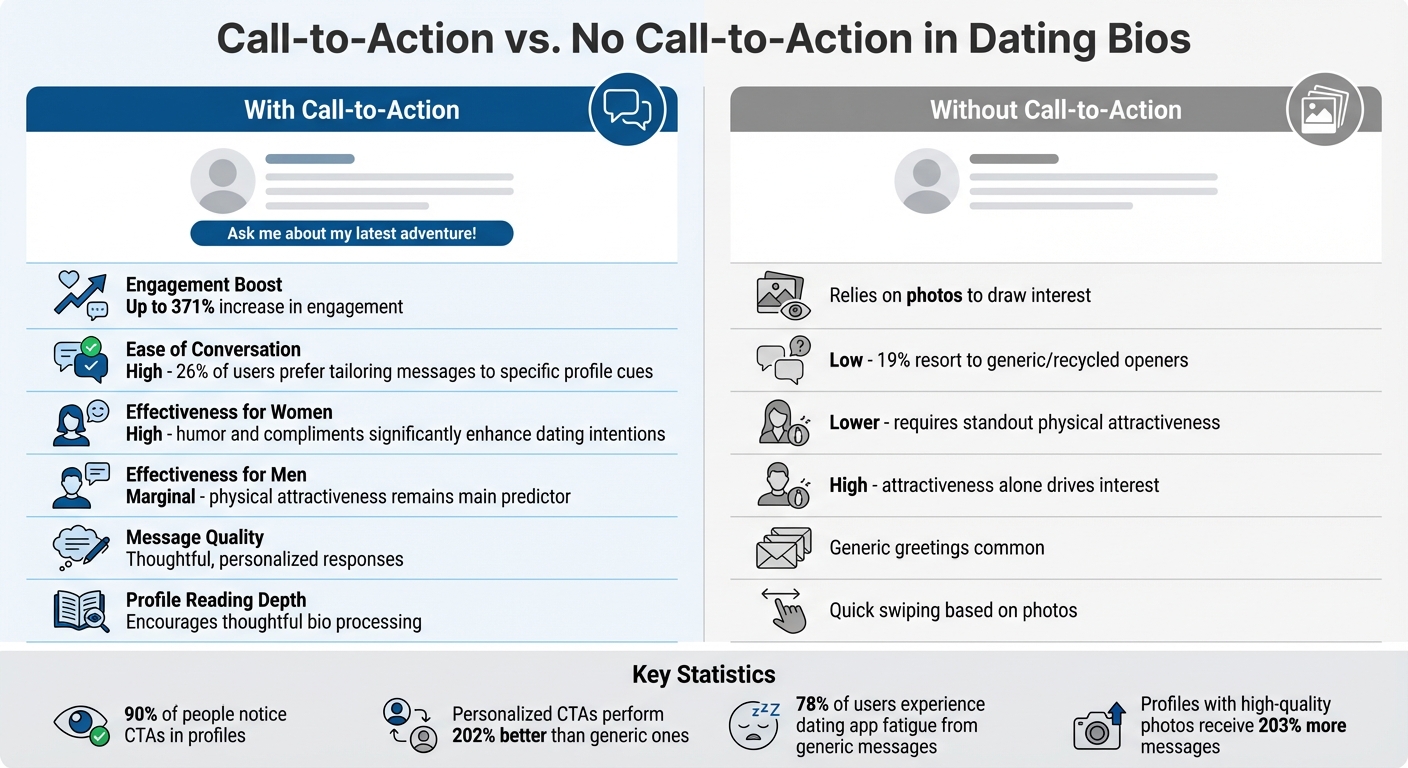
Dating Bio CTA vs No CTA: Engagement and Performance Comparison
CTA vs. No CTA Comparison Table
Deciding whether to include a call-to-action (CTA) in your dating profile can have a noticeable impact on how others engage with you. Here’s a breakdown of how profiles with and without CTAs measure up across key areas:
| Feature | Profile with CTA | Profile without CTA |
|---|---|---|
| Ease of Conversation | Higher; 26% of users prefer tailoring messages to specific profile cues [17]. | Lower; often leads to recycled or generic conversation starters (19%) [17]. |
| Perceived Openness | Higher; humor and compliments increase perceived positive traits [6]. | Neutral; relies heavily on the "what is beautiful is good" stereotype [3]. |
| Effectiveness (Men) | Marginal; physical attractiveness remains the main predictor of intentions [6]. | High; attractiveness alone drives many male users’ interest [6]. |
| Effectiveness (Women) | High; humor and compliments significantly enhance dating intentions [6]. | Lower; requires standout physical attractiveness to compensate for lack of textual cues [6][3]. |
| Engagement Depth | Encourages users to process the bio more thoughtfully [3]. | Promotes quick swiping based solely on photos [3]. |
Including a CTA makes it easier for others to start conversations. About 26% of users actively look for specific cues in profiles to personalize their opening messages [17]. Without these hooks, people tend to resort to generic greetings or overused pickup lines - contributing to the dating app fatigue that 78% of users report experiencing [17]. The table highlights how CTAs can shape interactions, but understanding the broader context is key to deciding whether this approach suits your goals.
Factors That Affect Which Approach Works Better
While the table provides useful data, several other factors influence how effective a CTA might be. For starters, photo quality can determine whether your bio - and any CTA in it - gets noticed at all. Extremely attractive or unattractive photos often lead to snap judgments, bypassing the bio entirely [3]. On the other hand, profiles with "moderately attractive" photos - where most users fall - rely more on the bio to make a lasting impression [3].
The device someone uses also plays a role. Desktop users tend to read profiles more thoroughly, which makes CTAs more impactful. Mobile users, however, focus more on visuals due to screen size, so shorter, punchier CTAs work better in that context [1].
Gender adds another layer of complexity. Women generally spend more time analyzing profiles and value text that reflects intelligence and ambition [1]. As Martin Graff, Ph.D., explains:
"The inclusion of textual information along with photographs enhances men's dating profiles more than women's profiles" [1].
For men, a CTA can provide clarity about interests, but physical attractiveness often remains the deciding factor [6]. For women, a well-placed CTA can balance out the initial visual impression and highlight personality [1].
Ultimately, your dating goals should guide your strategy. If you’re among the 52% of Gen Z users seeking long-term relationships [17], including a CTA that reflects your personality and sparks meaningful conversation can help. On the other hand, if short-term connections are your focus, high-quality photos might be enough to capture attention [2]. By tailoring your approach to these insights, you can create a profile that consistently resonates with your audience.
How High-Quality Photos Improve Profile Performance
Why Photos Matter for Profile Engagement
Your profile picture is like the front door to your online persona - it’s what invites people in to learn more about you. A study involving 445 participants revealed that a profile photo often outweighs other factors like bio details, occupation, or even intelligence scores when it comes to swiping decisions [2][3][4]. As Janneke M. Schokkenbroek, Ph.D., notes:
"A photo creates an instant mental shortcut to evaluate the other person, while reading a bio takes effort most swipers don't invest." [2]
Here’s the reality: profiles with high-quality photos receive 203% more messages, according to Match.com [20]. And if you don’t have a photo? You’re likely missing out - 58% of users won’t even consider connecting with a photo-less profile, while 34% say low-quality images are a deal breaker [19].
Quality photos don’t just grab attention; they create a "halo effect" - a psychological phenomenon where people associate positive traits with visually appealing photos [2][3]. This effect can even encourage users to spend more time reading your bio. For instance, when users view moderately attractive, high-quality photos, they’re more likely to focus on your bio text, whether it includes a call-to-action (CTA) or simply highlights your personality [3].
Specific photo choices can make a huge difference. Including at least one full-body shot can lead to a 203% increase in messages received [18]. Other tips? Women tend to get 60% more attention with indoor photos, while men see an 18% boost with outdoor shots [18]. Well-lit, recent photos can result in 74% more likes and 32% more messages [20]. These aren’t small changes - they can be the difference between blending into the crowd and standing out. Once your photos grab attention, they pave the way for your bio to shine. The next step is ensuring those photos reflect the best version of you, which is where Dating Photo AI comes in.
Using Dating Photo AI to Improve Your Profile Photos
Not everyone has access to professional photographers or the time for a full-blown photoshoot. That’s where Dating Photo AI steps in, offering a tech-savvy solution to create high-quality dating profile photos that look natural while addressing common issues that can hurt engagement.
Take smartphone selfies, for example. The wide-angle lens often distorts facial features, making your nose or forehead appear larger than they actually are [21]. Dating Photo AI fixes these distortions while keeping the essence of your appearance intact. All you have to do is upload your photos, and the AI works its magic, producing professional-grade images tailored for dating platforms. The goal? To dramatically increase your matches by upgrading the first impression your photos make.
The platform offers flexible options to suit different needs. The Starter plan provides 40 photos, the Dater plan includes 80, and the Casanova plan offers unlimited photos with custom prompts. Each plan comes with a satisfaction guarantee, and the turnaround is quick - no need to wait weeks for a photographer’s availability.
Shannon O'Malley, a professional photographer, sums it up perfectly:
"Your photos are your first impression - and your most powerful dating tool." [20]
Whether your bio includes a compelling CTA or simply lets your personality shine, none of it matters if your photos don’t grab attention. Dating Photo AI ensures your visuals meet the high standards of today’s dating platforms, giving your profile the boost it needs to truly stand out.
Conclusion
Deciding whether to include a call-to-action (CTA) in your dating bio isn’t about finding a one-size-fits-all answer - it’s about aligning your strategy with your goals. CTAs are especially effective if you want to make it easy for matches to take the first step. For instance, women who use specific date-related terms like "dinner", "drinks", or "lunch" in their profiles see a 73% boost in replies [22]. On the other hand, skipping the CTA relies on the strength of your photos and the natural charm of your personality to draw people in.
There’s also a deeper layer to consider: how different users engage with your profile. Gender plays a part here. Men tend to see better results when their bios highlight traits like intelligence or career achievements, while women often benefit from using activity-focused language that encourages interaction [1]. Additionally, mobile users lean heavily on visuals over text, making high-quality photos even more critical [1].
At the end of the day, your photos are the first hurdle. Even the most clever bio or well-crafted CTA won’t matter if your profile picture doesn’t grab attention [3]. As Janneke M. Schokkenbroek, Ph.D., wisely states:
"A photo may start a connection, but it won't sustain a relationship" [2].
This highlights the importance of having strong, attention-grabbing photos that compel people to explore your profile further.
That’s where tools like Dating Photo AI come into play. By fixing smartphone distortions and delivering professional-grade images, it ensures your visual first impression stands out. Whether you go with a CTA or let your photos do the talking, high-quality visuals give your profile the best chance to make an impact. Success ultimately lies in balancing engaging text with stunning visuals.
FAQs
What’s the best way to add a call-to-action (CTA) to my dating bio?
Adding a strong call-to-action (CTA) at the end of your dating bio can make all the difference in turning casual views into genuine matches. A good CTA nudges readers to take a specific step, like sending you a message or suggesting a fun date idea.
The key to an effective CTA? Keep it short, clear, and connected to something personal in your bio. For instance, if you mention your love for hiking, you might say, "Got a favorite trail? Send me your best recommendation!" A friendly, upbeat tone makes it feel like an invitation rather than a command. And by placing it as the final line of your bio, you ensure it’s the last thing they read - making it more likely they’ll act on it.
With a thoughtful CTA, your bio becomes more inviting and approachable, giving potential matches that extra nudge to reach out!
What are the downsides of including a call-to-action in a dating profile?
Including a call-to-action (CTA) in your dating profile can sometimes backfire. If it comes across as too demanding or feels like a list of rules, it might make you seem controlling or unapproachable - pushing potential matches away. For example, asking someone to jump off the app too quickly can create unnecessary pressure and even lead to doubts about your intentions.
CTAs that focus solely on what you want - like "Message me if you..." - might also give off a self-centered vibe. This approach can turn off people who are looking for a connection that feels mutual and balanced. Instead, aim to write a profile that sparks genuine interest and encourages conversation naturally, without making anyone feel like they have to follow specific instructions.
Why are high-quality photos more important if I don’t include a call-to-action in my dating bio?
High-quality photos are a game-changer, especially if your bio doesn’t include a call-to-action. Why? Because your pictures become the first and often the only thing people notice when deciding to swipe. Studies consistently show that visuals take the lead in how users form opinions on dating apps - photos matter more than words.
A crisp, well-lit, and flattering photo can make you seem approachable, trustworthy, and attractive, which naturally encourages more engagement - even if your bio doesn’t include a direct prompt. Skipping a call-to-action? No problem. A polished, high-resolution image can still make your profile stand out and increase your chances of matching.
This is where Dating Photo AI steps in. It creates professional-grade, natural-looking photos that highlight your best self. With these enhanced images, your profile can shine and boost your match rates - even without relying on a CTA.