
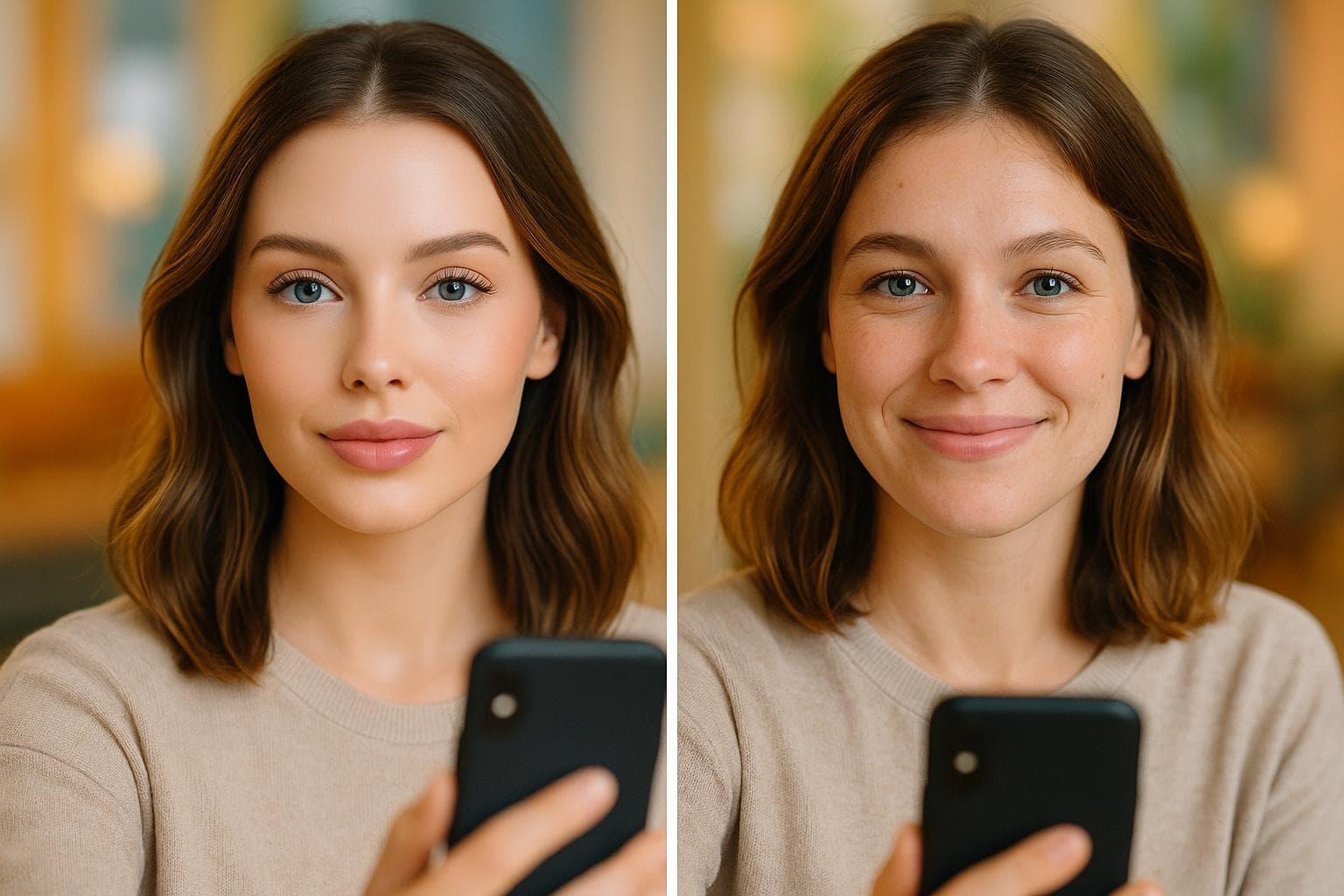
How Filters Affect Dating App Trust
Using filters on dating apps can boost your profile's appeal but may also create trust issues. Subtle edits often make photos more likable, while heavy filtering risks mismatches between online images and real-life appearances. This mismatch can lead to disappointment, skepticism, and strained connections.
Key takeaways:
- Subtle filters (e.g., minor skin smoothing, lighting tweaks) improve likability without hurting credibility.
- Excessive filters (e.g., reshaping features, heavy blurring) can feel deceptive and damage trust.
- Over-filtering creates a "reality gap", making in-person meetings awkward and reducing confidence for both parties.
- Tools like Dating Photo AI offer a middle ground by refining photo quality without altering natural features.
The balance is clear: small edits help you stand out, but staying true to how you look ensures lasting connections.
How Filters Shape First Impressions
On dating apps like Tinder, where decisions are made in less than a second, your profile photo holds immense power. In that fleeting moment, people form snap judgments - not just about your looks, but also about your personality, confidence, and authenticity. Filters, as a result, play a complicated role in shaping these first impressions. This phenomenon ties back to cognitive biases, which are explored below.
The Psychology Behind Filtered Photos
When someone encounters an enhanced photo, their brain processes more than just physical attractiveness. Thanks to the halo effect, polished images often come across as more trustworthy and confident. This aligns with the "beautiful-is-good" stereotype, where attractive faces are frequently perceived as more likable and dependable. On dating apps, where users only have a face and a short bio to go on, these mental shortcuts heavily influence whether someone swipes left or right.
Research shows that subtle filters can boost likability without compromising perceived trustworthiness. However, when filters are overdone - like enlarging eyes or creating noticeable distortions - they can backfire, making the image feel artificial and unrelatable [2].
Excessive editing can also trigger cognitive dissonance, leading to quick rejections and raising doubts about the person's authenticity [4].
What Heavy Filtering Communicates
The way you use filters sends subtle messages about how you present yourself. Small adjustments - like smoothing skin, tweaking colors, or brightening lighting - suggest you care about your appearance while staying genuine. These kinds of edits are similar to wearing flattering clothes or applying light makeup: they show effort without crossing into deception, aligning with the need for honest self-representation.
On the flip side, heavy filtering that drastically alters facial features, adds unnatural blurs, or uses exaggerated effects can communicate an attempt to hide your real appearance. In the fast-paced world of dating apps, these signals can be deal-breakers. Since matches often lead to in-person meetings, extreme edits can set unrealistic expectations, leading to disappointment or awkward situations. Interestingly, research indicates that reactions to heavy filtering vary by dating goals. While casual daters may be less concerned about heavy edits, those looking for serious relationships tend to prioritize authenticity.
In U.S. dating culture, the unspoken rule is to "put your best foot forward, but don’t misrepresent yourself." A completely unfiltered photo with poor lighting might seem authentic but fail to grab attention. On the other hand, a subtly enhanced image with warm lighting and slight skin smoothing can strike the perfect balance, making you appear both attractive and approachable. Overly filtered photos, however, risk coming across as fake, which can lead to instant dismissals in the rapid-fire swiping environment.
Tools like Dating Photo AI aim to achieve this balance by using advanced AI to refine technical elements such as lighting, sharpness, and composition while maintaining your natural look. For U.S. users who want polished, professional photos without losing authenticity, these tools can help create a strong first impression and lead to more meaningful connections.
These insights highlight the importance of balance - a concept explored further in the next section.
When Filters Damage Trust
While small edits can make your photos pop, going overboard with heavy filtering can lead to problems that go far beyond a bad first impression. When your dating profile photos no longer match how you actually look, the fallout can affect both you and the people you meet - often leaving behind trust issues that are hard to repair.
The Reality Mismatch Problem
Using beauty filters or reshaping tools to slim your face, enlarge your eyes, smooth your skin, or tweak your jawline and nose may seem harmless at first. But these changes erase the natural features that make you, well, you [1][2]. Augmented reality (AR) enhancements, when overused, create noticeable gaps between your online photos and your real-life appearance, especially during in-person meetings [4]. Research on Tinder users reveals that these discrepancies can lead to immediate disappointment, reduced attraction, and, in some cases, dates ending prematurely [4].
When someone notices that your photos were heavily edited, they may start questioning your honesty: "If they edited this, what else might they be hiding?" This doubt can spill over into other parts of your profile, such as your stated age, lifestyle, or relationship goals. Over time, repeated mismatches foster a culture of skepticism, where users assume that "everyone's stretching the truth a little." This mindset can lead to harsher judgments, more selective swiping, and even a reluctance to meet in person. These mismatches don't just affect initial impressions - they lay the groundwork for deeper trust issues.
How Mismatches Impact Both Sides
For the person viewing your profile, discovering a major photo mismatch can lead to feelings of disappointment, frustration, and even betrayal [4]. Some describe the experience as "catfishing lite." It can feel like a waste of emotional energy and time, prompting users to become more cautious. They might start asking for unfiltered selfies, insist on video calls before meeting, or, in some cases, abandon matches altogether.
For the person behind the filtered photos, the emotional toll can be just as heavy but different. While heavily edited pictures might initially attract more attention and compliments, they often lead to anxiety and self-doubt [4]. Many worry that their real appearance will let others down, leading them to delay or even cancel meetups. This fear can create a cycle where positive feedback on altered images reinforces insecurities, pushing them to rely even more on filters.
What’s meant to enhance your online appeal can end up being a barrier to genuine connection. To avoid these pitfalls, focus on improving your photos in ways that stay true to who you are - like adjusting lighting, sharpness, and composition. Tools like Dating Photo AI can help you create polished, professional-looking images that still reflect your authentic self. This approach not only reduces the risk of awkward first dates but also helps build trust and foster real connections.
sbb-itb-06ba92c
How to Enhance Photos Without Losing Authenticity
You can improve your dating profile photos while staying true to your real appearance. Some edits enhance clarity and quality without altering how you look, while others can create mismatches that undermine trust.
Acceptable vs. Deceptive Photo Edits
Acceptable edits focus on technical adjustments that improve photo quality without changing your features or body shape. For example, tweaking brightness, contrast, and exposure can make your face more visible. Color correction can fix harsh lighting tones, and mild skin smoothing can reduce graininess from low-light photos while keeping your natural skin texture intact. Sharpening the image to bring out details is another safe option. Research shows that subtle filters, which make small, almost undetectable changes, can actually increase how people perceive a face without lowering trustworthiness [1][2][3].
Deceptive edits, on the other hand, alter your appearance in ways that create unrealistic expectations. Tools that reshape your facial structure or give you a "doll-like" appearance are misleading [1][2][3]. Similarly, body morphing to change proportions or heavy skin blurring that erases natural texture goes too far. Filters that make you look significantly younger or change permanent features, like your hairline, are also problematic.
Here’s a quick breakdown to help you decide what’s acceptable:
| Filter / Edit Type | Example Use | Effect on Trust | Effect on In-Person Meeting |
|---|---|---|---|
| Lighting & contrast adjustment | Brightening a dim selfie | Neutral to positive | You look the same, just better lit |
| Subtle skin smoothing | Reducing grain in low light | Neutral if texture remains [1][2][3] | Still recognizable |
| Color correction | Fixing indoor lighting tones | Neutral improvement | No noticeable mismatch |
| Heavy skin blur | Erasing all lines and pores | Feels fake or staged | Face appears more textured |
| Face reshaping | Altering jaw, nose, lips | Dishonest when revealed | Strong mismatch; damages credibility |
| Eye enlargement | Cartoonishly bigger eyes | Playful but unrealistic [1][2] | Not suitable for serious profiles |
| Body morphing | Changing proportions | Perceived as dishonest | Common dealbreaker |
The rule of thumb: If someone who knows you well would say, "That doesn’t look like you", the edit has gone too far.
By understanding the difference between acceptable and deceptive edits, you can focus on capturing photos that naturally highlight your best features.
Tips for Natural-Looking Photos
Great photos need fewer edits. When you start with quality images, only minor touch-ups are necessary to keep things authentic.
- Use natural light. Stand by a window or go outside in the morning or late afternoon for soft, flattering light. Avoid overhead indoor lighting, which can cast unflattering shadows. If indoors, stand near a side window or lamp for better results.
- Pick a clean background. Simple settings like plain walls, parks, or coffee shops keep the focus on you. Avoid cluttered or messy spaces that can distract.
- Wear your real style. Choose clothes you’d actually wear on a first date - casual but polished. For most, this might mean a well-fitting T-shirt and jeans or a casual button-down. Avoid outfits that feel out of character, like formal wear or gym clothes (unless you’re genuinely at the gym).
- Use your phone’s rear camera. The rear camera generally has better quality than the front-facing one. If you’re taking selfies, a tripod and timer can help you get flattering angles.
- Hold the camera at eye level. Extreme angles can distort your face. Eye-level shots provide the most accurate and flattering representation.
When editing, stick to simple adjustments. Increase brightness just enough to make your features clear without washing out your skin. Adjust contrast slightly to add depth, but avoid harsh shadows. If indoor lighting looks too yellow, cool it down a bit. If you appear pale, add a touch of warmth. Light sharpening can fix soft images, but don’t overdo it - too much sharpening can make photos look unnatural.
It’s okay to remove small imperfections like a pimple, but leave permanent features like freckles, birthmarks, and scars untouched. Cropping distractions and straightening tilted horizons can also improve composition without altering your appearance.
Using AI to Create Realistic Photos
AI tools offer a quick and effective way to enhance your photos while keeping them true to life. Dating Photo AI is one such tool that uses advanced technology to create high-quality images from your selfies. The process is simple: upload a few selfies, and the AI generates polished photos with different backgrounds and poses. As of 2025, Dating Photo AI has helped 53,328 singles improve their profiles [5].
The platform offers three pricing plans: Starter ($39 for 40 photos), Dater ($55 for 80 photos), and Casanova ($199 for unlimited photos with custom backgrounds and outfits). Compared to hiring a professional photographer, which can cost around $300, these plans are more budget-friendly.
What sets AI tools like this apart is their ability to enhance lighting and composition without altering your natural features. Unlike apps that reshape your jawline or enlarge your eyes, these tools focus on improving photo quality while ensuring you still look like yourself. This approach helps you stand out on dating apps while maintaining the trust that comes from matching your photos in real life.
The goal isn’t to create a completely different version of yourself - it’s to showcase the best version of you, as you’d look on a great day with perfect lighting. That kind of authenticity lays the groundwork for meaningful connections that go beyond the first date.
Conclusion
Keeping your photos genuine is crucial for building trust on dating apps. When there's a big difference between your photos and how you look in person, it often leads to disappointment and rejection [4]. Overusing filters can create what researchers call an "ideal–reality gap." The bigger the gap, the more likely your date will feel misled when you meet [4].
But staying authentic doesn’t mean you can’t look your best. Using good lighting, thoughtful angles, and small edits can highlight your features without crossing the line into deception. The real issue arises when filters drastically change your appearance - reshaping your face, altering your body, or erasing unique features.
Realistic photos come with practical perks. You’ll attract people who are genuinely interested in the real you, feel more confident during dates, and avoid the stress of wondering if your pictures match reality. Research shows that profiles with obvious edits are often dismissed because people expect in-person mismatches [4].
If you need help creating polished but authentic photos, Dating Photo AI offers a solution. This platform uses advanced tools to enhance your images by improving lighting, tidying up backgrounds, and capturing natural poses - all while staying true to your actual appearance. It bridges the gap between casual selfies and pricey professional shoots, ensuring your photos remain honest.
The goal is simple: edit to enhance, not to transform. Pick photos you’d feel comfortable sharing under the bright lights of a coffee shop on a first date. Honest photos lead to genuine attraction and lay the foundation for meaningful connections. Trust built on authenticity can turn a swipe into a second date - and maybe even something more.
FAQs
How can I use photo filters on dating apps without losing trust?
Using filters on dating app photos can help make your profile stand out, but going overboard with edits might backfire if your pictures don't match how you actually look. It's all about finding that sweet spot - making slight tweaks to enhance your natural features without completely changing your appearance.
For a polished yet genuine vibe, try using tools that rely on advanced AI to produce high-quality images. These tools can help you present yourself in the best light while staying true to who you are, which is key to building trust with potential matches.
How do overly filtered photos on dating apps affect trust and authenticity?
Using heavily filtered photos on dating apps can create a disconnect between your online presentation and your real-life appearance. This mismatch can sometimes lead to disappointment or even mistrust when meeting someone face-to-face, as they may feel misled.
For a more genuine approach, stick to subtle edits that enhance your natural features without drastically changing how you look. Tools like AI-based photo enhancers can be a great way to produce clear, high-quality images that still represent the real you. A polished yet honest profile helps set the stage for trust, starting with how you present yourself in your photos.
How can over-editing photos on dating apps impact trust?
Over-editing photos can set up unrealistic expectations, which might lead to disappointment when meeting someone in person. This can leave others feeling misled and may weaken trust in the connection.
The key to staying genuine is to enhance your photos in a way that highlights your natural features without drastically changing how you look. Subtle edits, paired with tools like advanced AI, can help you create high-quality images that still feel true to who you are. This way, you can make a positive impression while keeping things authentic.