
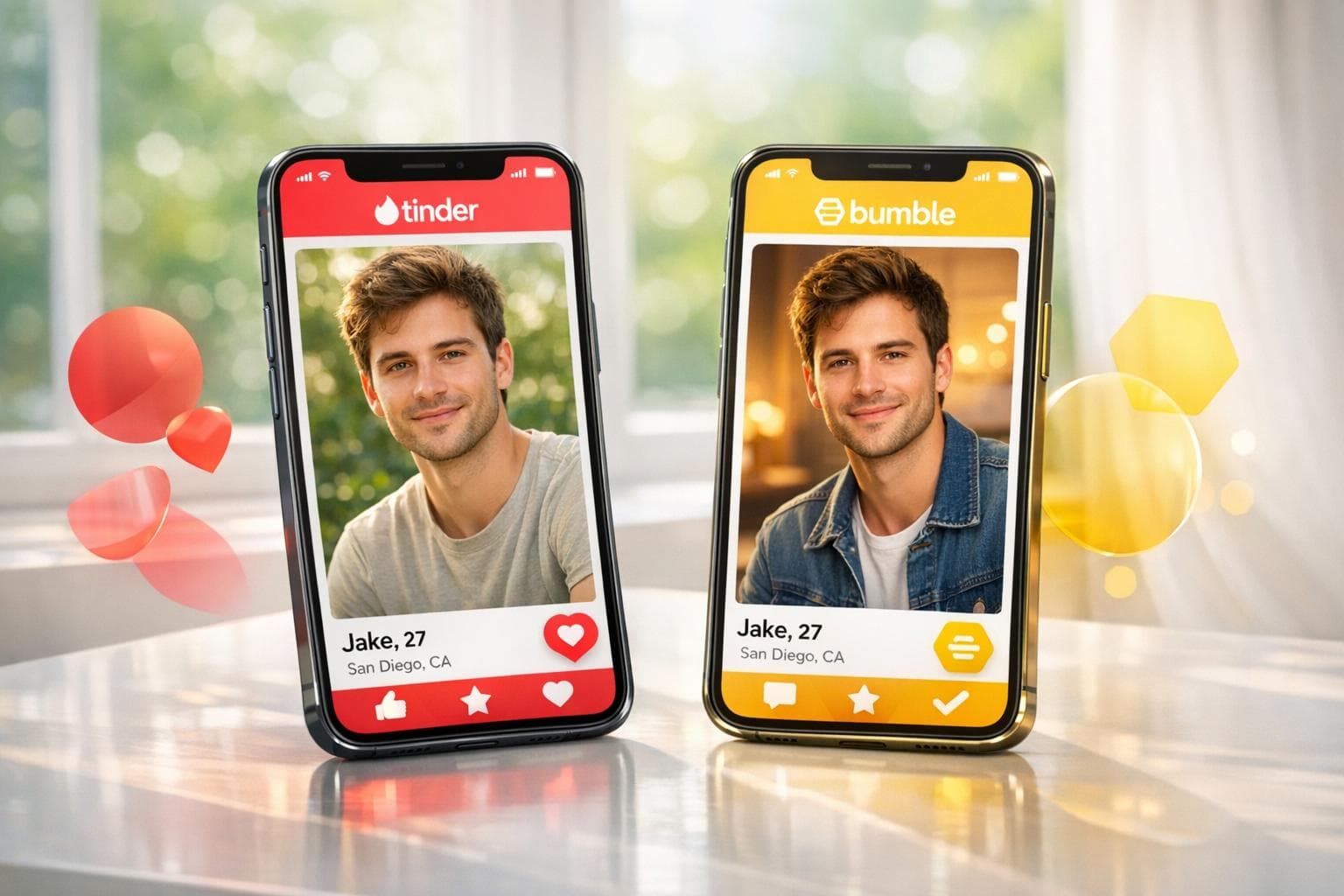
AI Photos on Tinder vs. Bumble
AI-generated photos are changing how people use dating apps like Tinder and Bumble. Here's why they matter:
- Match Rate Boost: AI-enhanced photos achieve a 34.2% match rate, far higher than the 12.6% for regular smartphone images.
- Faster Decisions: On Tinder, users make swipe decisions in just 1–2 seconds, making high-quality photos critical.
- Platform Differences: Tinder prioritizes visually striking, casual photos, while Bumble values confidence and lifestyle-focused images.
- Cost-Effective: AI tools cost $29–$49, compared to $300–$800 for professional photography.
- User Challenges: 52% of singles struggle to pick the right profile pictures, and AI tools simplify this process.
Quick Comparison
| Feature | Tinder | Bumble |
|---|---|---|
| Focus | Visual-first, quick swipes | Safety, meaningful connections |
| Photo Style | Casual, eye-catching | Confidence, lifestyle |
| AI Integration | Photo Selector, Verification | Deception Detector |
| Match Rate (AI) | Higher with polished photos | Higher with respectful photos |
AI tools like Dating Photo AI help users craft better profiles tailored to each platform, increasing match rates and engagement while saving time and money.
How AI Photos Work on Dating Apps
AI photo technology comes in two main forms. The first scans your camera roll - like Tinder's Photo Selector - to pick the best photos using facial recognition [3]. The second creates brand-new, professional-grade images from 8–15 selfies [4].
AI generators rely on machine learning models trained on data from successful dating profiles. These models assess facial features, lighting, composition, and body language to create images that maximize engagement [4]. The focus is on "natural realism", keeping skin texture and backgrounds sharp to avoid an overly edited or fake appearance.
Tinder's Photo Selector, for example, processes data directly on your device to prioritize privacy. It automatically removes group photos, which might confuse viewers, and filters out images that don’t meet community guidelines [6]. Its AI is trained on diverse datasets to ensure it works well across a broad range of users.
"Our vision is to use AI as an enabler in the dating journey… at Tinder, we use innovative technologies to create a safe space for people to make authentic connections." - Faye Iosotaluno, CEO, Tinder [3]
The impact of AI photos is clear. In one trial, a dating profile upgraded with AI-generated images jumped from zero matches in 62 days to 236 matches in just 30 days. This raised the match rate from a typical 2.8% to an impressive 8.4% [4]. These advancements lay the groundwork for the benefits and strategies that follow.
Benefits of Using AI Photos
One of the biggest hurdles for dating app users is choosing the right profile pictures. In fact, 52% of users report struggling to find photos that truly represent them, often spending an average of 33 minutes on this task [1]. For men, including more than one clear photo of their face can increase their chances of matching by 71% [5].
AI-generated photos offer a solution by providing far more variety than your camera roll. These tools can create images of you in different settings, outfits, and poses that you might not have thought to capture yourself [4]. This diversity makes profiles appear more complete and engaging - something dating platforms tend to favor.
They’re also a budget-friendly alternative to professional photographers. AI generators typically cost between $29 and $49 and deliver results within minutes. Compare that to professional photo shoots, which can run $300–$800 and take up to two weeks. For dating-specific needs, AI photos deliver nearly the same quality at a fraction of the cost [4]. And given how user preferences vary across platforms like Tinder and Bumble, high-quality images are essential.
Why Tinder and Bumble Matter for AI Photos
As two of the biggest names in online dating, Tinder and Bumble are prime platforms for testing how well AI photos perform. Tinder, for instance, is highly visual. Swipe decisions happen in just a few seconds, so your photos need to grab attention immediately [2].
Both platforms have invested heavily in AI. A survey found that 68% of Tinder users would find an AI-powered photo selection tool helpful, which led to the creation of Photo Selector [6]. Tinder also uses AI for its Photo Verification feature, where live video is compared with profile photos. Verified users aged 18–25 have seen a 10% increase in matches, proving the value of such tools [5].
Bumble, on the other hand, focuses on safety with its "woman-first" approach. Its AI tools include a "Deception Detector" that blocks spam and fake profiles with a 95% success rate, and a "Private Detector" that automatically blurs explicit images [5]. These features highlight the importance of maintaining authenticity and respect while enhancing visual appeal.
Together, these platforms showcase different user priorities, emphasizing the need to adapt your AI photo strategy to each app’s unique environment. Whether it’s Tinder’s swipe-first culture or Bumble’s safety-driven ethos, leveraging AI photos effectively can lead to higher match rates and stronger engagement.
Tinder vs. Bumble: AI Photo Performance Comparison
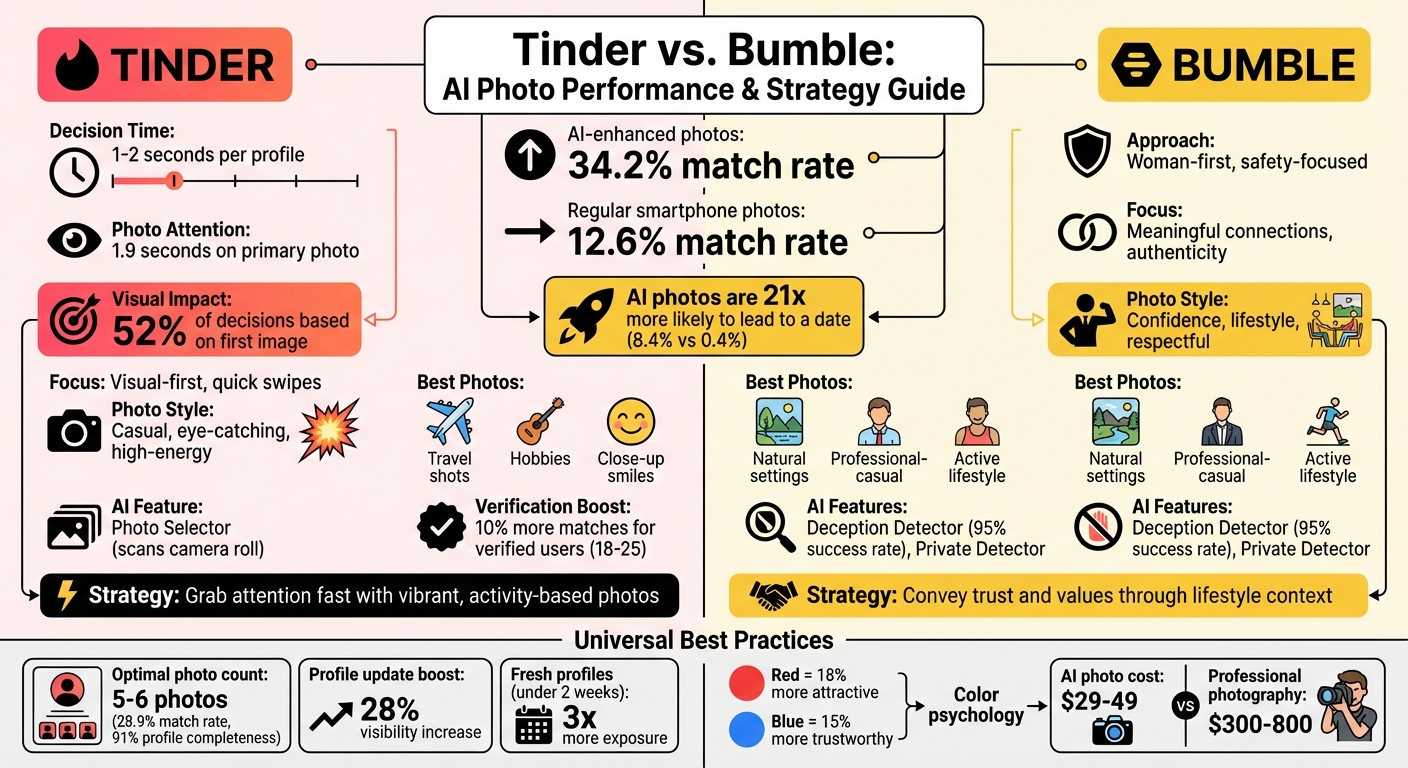
Tinder vs Bumble AI Photo Performance Comparison
Match Rates and User Engagement
A study analyzing 1,847,293 profiles (spanning January 2024 to June 2025) revealed that photos enhanced with AI achieved a 34.2% match rate, compared to just 12.6% for regular smartphone images [2]. Even more striking, AI-optimized photos were 21 times more likely to lead to a date (8.4% vs. 0.4% conversion rate) [2].
The way Tinder and Bumble drive engagement differs significantly. Tinder is a visual-first platform, where users decide to swipe in just 1–2 seconds. On average, a primary photo gets only 1.9 seconds of attention, and 52% of swipe decisions are based entirely on that first image [2]. This makes it critical for AI-enhanced photos to grab attention immediately.
Bumble, on the other hand, emphasizes safety and meaningful connections with features like its "For You" section, which provides users with four curated matches daily [5]. While Bumble users still respond well to high-quality photos, the platform's woman-first approach means your images should convey confidence and respect, not just visual appeal. Bumble also employs a "Deception Detector" to block 95% of fake profiles and allows users to report AI-generated content, reinforcing its focus on authenticity [5].
In December 2025, researcher Jacob Zaki ran a 30-day experiment in the San Francisco Bay Area to compare AI photo performance across dating apps. After spending $418.73 testing eight different AI photo generators, Zaki saw his match count jump from zero (over a previous 62-day baseline) to 236 matches in just 30 days. This pushed his match rate from the typical male average of 2.8% to an impressive 8.4% [4].
These findings highlight how AI-enhanced photos can significantly impact engagement, but each platform has unique preferences for photo styles.
Photo Preferences by Platform
Beyond match rates, visual styles play a huge role in user engagement, and each platform has its own preferences. Tinder’s algorithm, through its Photo Selector tool, focuses on lighting and composition. This feature scans your camera roll and suggests images that align with its performance data [7][3]. Tinder favors casual, high-energy photos - such as travel shots, hobby-related activities, or close-up smiles. These types of images are designed to captivate users in the crucial 1–2 second swipe window [4].
Bumble, however, prioritizes authenticity and lifestyle context. The platform’s focus on creating "equitable connections" means AI-enhanced photos should highlight your interests and values. Photos showing you in active or interest-based settings - like outdoor activities or professional-casual environments - tend to perform well with Bumble’s safety-conscious audience [4].
Interestingly, while 78% of users say they prefer "authentic" photos in surveys, behavioral data shows they swipe right 41% more often on subtly enhanced photos [2]. The trick is to avoid over-editing. AI photos that retain natural skin textures (like visible pores) and sharp, realistic backgrounds perform best. Overly polished or "plastic-like" images, however, can create a negative impression by triggering the "uncanny valley" effect [4].
Both platforms reward profile updates. Regularly refreshing your photos can boost your algorithmic visibility by 28%, and profiles updated within two weeks get three times more exposure [2]. AI photo generators are especially helpful for keeping profiles fresh and optimized.
When it comes to the number of photos, six is the magic number. Profiles with 5–6 photos achieve a 28.9% match rate and are perceived as 91% complete by users. In contrast, profiles with 10 or more photos often come across as "trying too hard" [2]. Tools like TruShot make it easy to hit this sweet spot, offering 60+ AI-generated photos in under a minute for $29, giving users plenty of options to curate their best six [4].
sbb-itb-06ba92c
Best Practices for Using AI Photos on Tinder and Bumble
Customizing Photos for Each Platform
Each dating app has its own vibe, so your AI-generated photos should match the energy of the platform you're using. Tinder and Bumble, for example, require slightly different approaches to make the best impression.
On Tinder, where decisions happen in just 1–2 seconds, your photos need to grab attention fast. Start with a close-up featuring a Duchenne smile - it’s been shown to significantly boost match rates [2]. Follow this up with images that showcase your hobbies, travel adventures, or other activities that highlight your fun side.
Bumble, on the other hand, leans into its woman-first ethos, which calls for a more thoughtful presentation. Your photos should convey respectful confidence. Use clear headshots and active lifestyle images, but steer clear of anything that feels overly casual or unsafe [4]. Photos taken in natural settings - like parks, coffee shops, or other relaxed outdoor environments - work well to establish trust and align with Bumble’s focus on meaningful connections.
Here’s a bonus tip: colors matter. Wearing red can make you appear 18% more attractive, while blue can increase trustworthiness by 15% [2]. To help the AI generate the best possible results, provide 5–10 source photos with varied angles, lighting, and expressions [8][4].
Before uploading any AI-enhanced images, double-check for issues like distorted features, unnatural lighting, or over-editing. Overly polished, "plastic-like" photos can create a negative impression by triggering the uncanny valley effect [5][4]. Also, keep in mind that Bumble’s Deception Detector actively filters out images that don’t meet its authenticity standards [5][4]. To avoid this, make sure your photos maintain visible skin texture and have sharp, natural backgrounds.
Using Dating Photo AI for Better Results
If you’re looking for an easy way to create standout photos, Dating Photo AI can be a game-changer. By uploading your source images, this tool generates high-quality photos that reflect your personality while maintaining the natural, authentic look that Tinder and Bumble value. The service offers three plans - Starter (40 photos), Dater (80 photos), and Casanova (unlimited photos with custom prompts) - so you can curate the perfect 5–6 photo lineup for your profile.
One of the biggest advantages of using Dating Photo AI is its ability to sidestep common pitfalls like inconsistent lighting or over-editing. Plus, updating your profile monthly can boost its visibility in the app’s algorithm by 28% [2]. Regularly refreshing your photos with this tool ensures your profile stays fresh and engaging. The AI-generated images are also designed to pass Tinder’s Photo Verification and Bumble’s safety checks, which can lead to higher match rates [2].
"The goal isn't to become a different person. It's to get dating profile pictures that look like they were taken by a talented friend on a day you were feeling your absolute best." - Alexander Liebisch, Author, TinderProfile.ai [8]
With fast delivery, you can experiment with different styles to see what works best for your dating goals. Whether you’re aiming for Tinder’s laid-back, high-energy vibe or Bumble’s confidence-driven approach, this tool can help you put your best foot forward.
Conclusion
The numbers speak for themselves: using AI-enhanced photos can significantly boost your dating success on platforms like Tinder and Bumble. These polished images yield a 34.2% match rate, compared to just 12.6% for amateur pictures, making users 21 times more likely to land an actual date [2].
With this in mind, it’s worth tailoring your strategy. On Tinder, a close-up smile paired with an engaging activity shot grabs attention in just 1.9 seconds. On Bumble, where the focus leans toward meaningful connections, confident yet approachable lifestyle photos resonate with its woman-first approach [2][4][3][5].
AI-powered photo tools make achieving professional-quality images more accessible and affordable [2]. Dating Photo AI, for instance, offers three plans to suit different needs: Starter (40 photos), Dater (80 photos), and Casanova (unlimited photos and custom prompts). These tools help create platform-ready images that not only pass face verification but also stay true to your natural look.
FAQs
How do AI-generated photos improve match rates on dating apps like Tinder and Bumble?
AI-generated photos have the potential to dramatically improve match rates by helping users present their best selves. These tools focus on elements like lighting, composition, and facial expressions to craft high-quality images that grab attention and connect with potential matches.
Studies confirm that choosing the right profile photos plays a key role in succeeding on dating apps, yet many people find this challenging. By automating the selection process, AI ensures your profile emphasizes your most appealing features, boosting confidence, encouraging more interactions, and increasing the chances of forming meaningful connections.
How do photo preferences differ between Tinder and Bumble?
Tinder and Bumble approach profile photos differently, reflecting the distinct vibes of their user communities and platform features. On Tinder, eye-catching, high-quality images - think professional or AI-enhanced photos - tend to grab attention. Since swipe decisions often hinge on that first photo, polished, well-lit pictures that pop can make all the difference in boosting your match potential.
Bumble, however, leans more into genuine and personality-driven photos. While crisp, high-quality images are still appreciated, users often gravitate toward pictures that feel real and relatable - like ones that highlight hobbies, interests, or a warm, natural smile. Both platforms support AI-enhanced photos, but Tinder focuses on creating that instant visual wow-factor, while Bumble aims to spark meaningful connections with a more personal and down-to-earth approach.
How can I make sure my AI-generated photos look authentic and not overly edited?
To make your AI-generated photos feel natural and convincing, aim for images that highlight your true appearance while improving quality. Use tools that preserve realistic skin tones, avoid overly smooth textures, and skip exaggerated filters. Simple tweaks - like enhancing lighting or sharpening details - can elevate your photos without making them look fake.
Another smart move? Combine AI-generated photos with real ones to keep your profile approachable and credible. Over-editing can create a mismatch between your photos and how you look in person, which might lead to disappointment or even mistrust. The secret lies in finding the right balance: enhance your photos while staying true to your authentic self. This way, you’ll draw genuine attention and build more meaningful connections.