
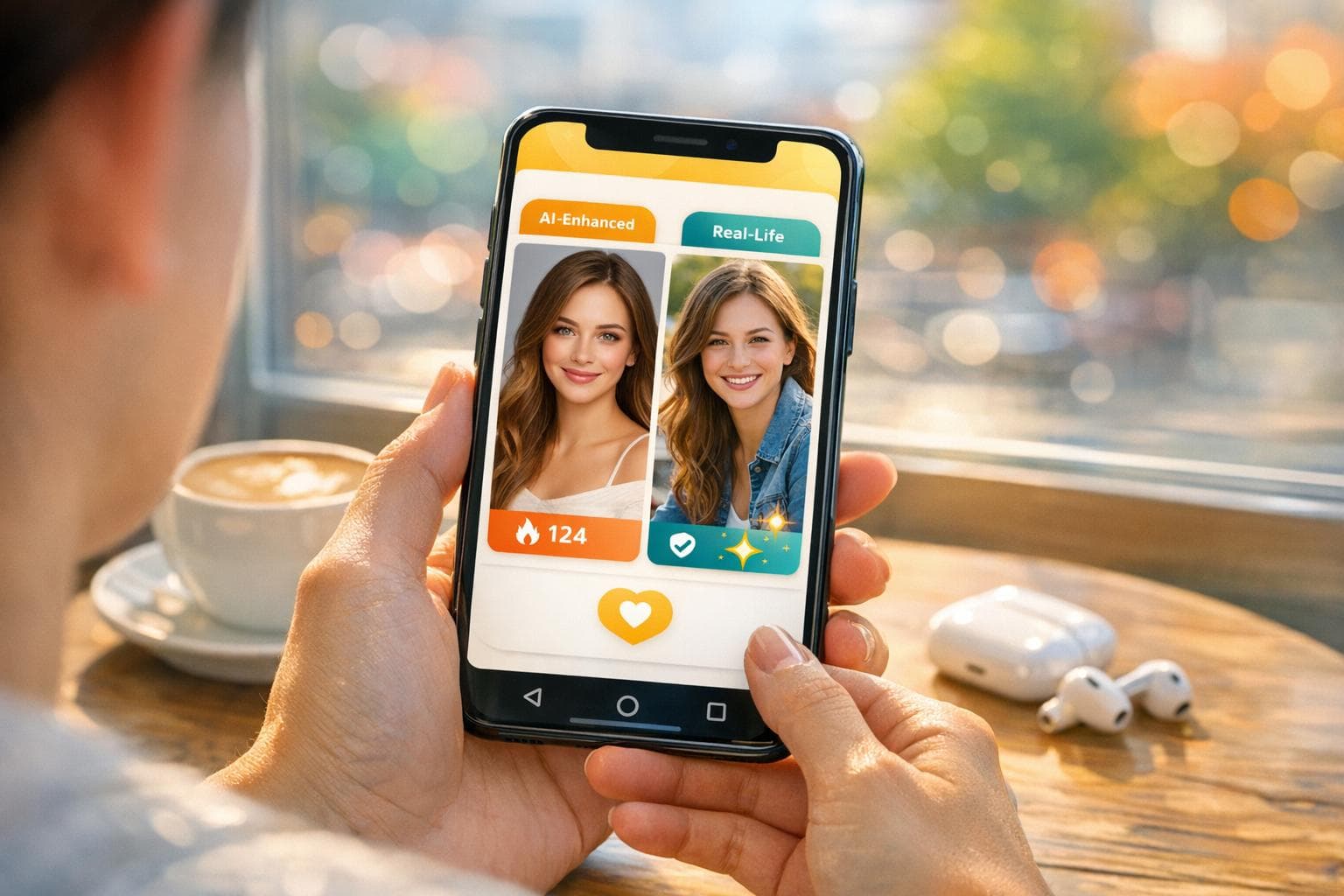
AI-Generated Photos for Bumble: Do They Work?
If you're trying to boost your Bumble profile, you might be wondering: Are AI-generated photos worth it? Here's the quick answer: AI-generated photos can increase match rates significantly, but they come with risks like reduced trust and recognition by other users. Meanwhile, Bumble's built-in AI Photo Feedback Tool helps improve your real photos for free, focusing on authenticity and ease of use.
Key Takeaways:
-
AI-Generated Photos (e.g., Dating Photo AI):
- Create polished, professional-looking images.
- Claims to boost match rates up to 10×.
- Can cost $19+ per month but may appear artificial to others.
-
Bumble's AI Photo Feedback Tool:
- Analyzes your existing photos for better quality and appeal.
- Free and integrated directly into Bumble.
- Focuses on improving real images rather than creating synthetic ones.
Quick Comparison:
| Feature | Dating Photo AI | Bumble's AI Photo Feedback Tool |
|---|---|---|
| Photo Source | AI-generated from selfies | Uses your existing photos |
| Cost | Paid ($19+ per month) | Free |
| Match Rate Impact | Up to 10× increase | Up to 272% improvement |
| Ease of Use | Requires external uploads | Fully integrated in the app |
| Trust Factor | Lower (synthetic images) | Higher (real photos) |
Both options have their strengths, but blending natural photos with AI-generated ones may strike the best balance between visual appeal and trustworthiness. Keep reading for a deeper dive into how each approach works and what might be right for you.
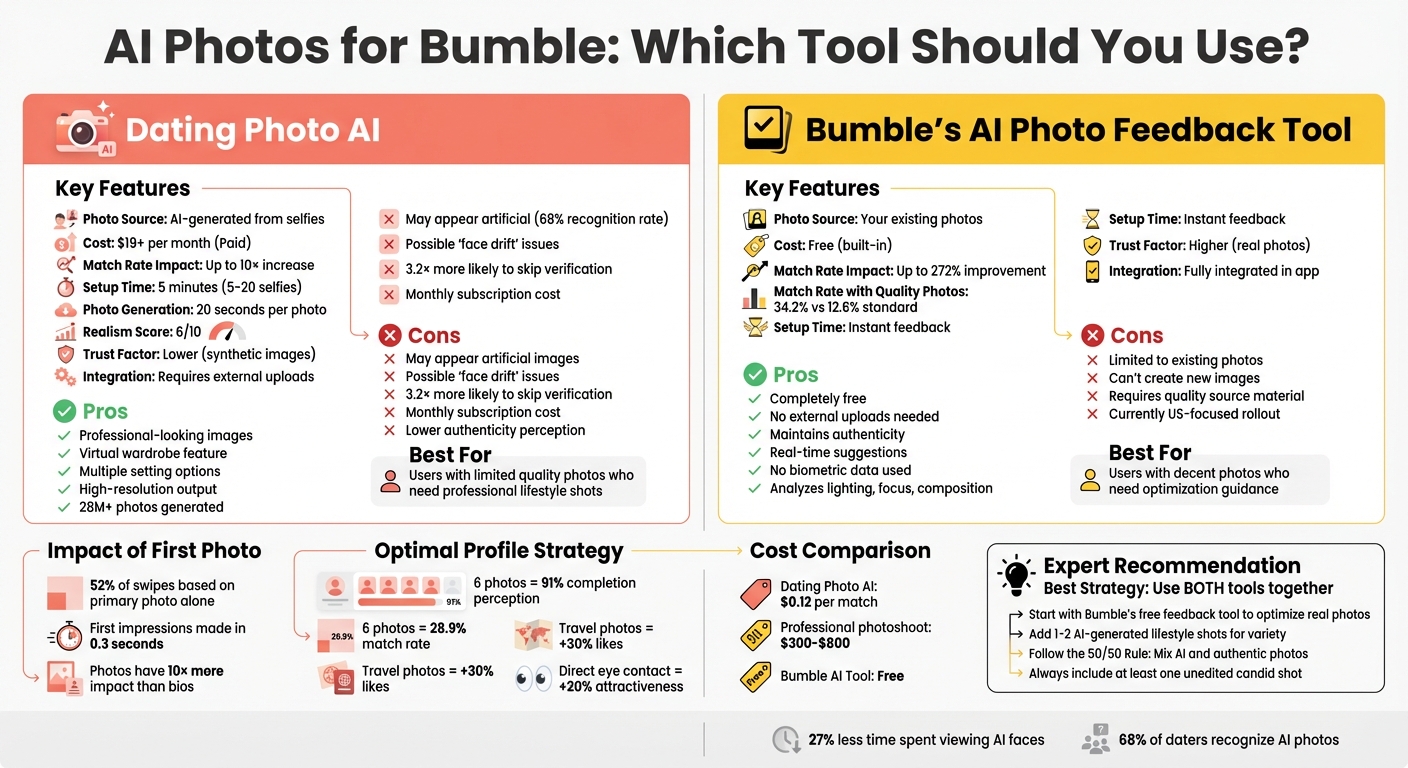
Dating Photo AI vs Bumble AI Photo Feedback Tool Comparison
1. Dating Photo AI
This section dives into how Dating Photo AI reshapes Bumble profiles by generating entirely new images using artificial intelligence.
Unlike Bumble's built-in photo analysis tool, Dating Photo AI creates fresh images from scratch. The process is simple: upload 5–20 selfies, and the AI builds a personalized model based on your photos. The setup takes just about 5 minutes, and once the model is ready, you can generate individual photos in around 20 seconds [1].
Photo Quality
Dating Photo AI offers photo packs specifically tailored for Bumble, focusing on clear facial details, natural body language, and visually appealing aesthetics [1]. You can even pick from various settings that would typically cost a lot to replicate in a traditional photoshoot [1]. A standout feature is the "virtual wardrobe", where you can upload a screenshot of an outfit from brands like Zara or Shein to see how you'd look in it [1].
To make the images feel more authentic, the AI uses techniques like resolution upscaling, scene relighting, and adding film-like grain [1]. However, realism isn't always perfect. In a 2026 test, Dating Photo AI scored a 6/10 for realism, with some users reporting "face drift", where the image resembled a sibling more than themselves [3]. Premium 2025 models have improved significantly, offering natural skin textures and sharp backgrounds. In contrast, older or free versions often result in overly smooth, easily recognizable AI-generated images [2].
Better photo quality doesn't just make profiles look good - it can also lead to more matches.
Impact on Matches
High-quality AI-generated photos can significantly boost match rates. For example, male users typically see a 2.8% match rate, but with premium AI photos, this can jump to 12%–15% [8]. In one 30-day experiment, premium AI photos led to 236 matches across major dating apps, while low-quality original photos yielded none [8]. At just $0.12 per match, AI photos are far more affordable than professional photoshoots, which can cost between $300 and $800 [8].
Certain types of images perform better than others. Travel-themed photos or scenic backdrops can increase likes by 30%, and direct eye contact with the camera can boost attractiveness ratings by over 20% [10, 11]. Experts suggest using the "50/50 Rule": combine AI-generated photos with natural, candid shots to maintain a balance between attractiveness and authenticity [9].
Ease of Integration with Bumble
Uploading AI-generated photos to Bumble is hassle-free. Simply download your high-resolution images and place your three strongest ones in the first slots of your profile. This strategy works well with Bumble's "Best Photo" algorithm, which prioritizes the image with the highest right-swipe rate [10]. Since most users spend less than 3 seconds on the first photo, this placement is critical [10]. To date, the platform has generated over 28 million photos, highlighting its popularity [1].
However, there are some caveats. While top-tier 2025 AI models can pass Bumble's face verification, lower-quality images might fail to convey the desired authenticity and could trigger "neuro-perceptual friction" [2, 3]. Profiles relying heavily on AI-generated photos are also 3.2× more likely to skip video verification, which can hurt their trust score [2]. Additionally, dating platforms are increasingly analyzing EXIF metadata (like GPS and timestamps) to detect AI-generated content, which can sometimes lead to lower profile visibility in discovery feeds [2].
sbb-itb-06ba92c
2. Bumble's Built-in AI Photo Feedback Tool
Bumble's AI Photo Feedback Tool is designed to help you choose your best photos by analyzing the ones you already have. Unlike tools that create synthetic images, this feature focuses on improving your existing pictures. Integrated directly into the profile editor, it provides real-time suggestions during both setup and updates. Just tap the "Get Feedback" button, and the AI will instantly scan your photos for common issues [12][11].
This tool combines instant guidance with practical tips to enhance your profile's visual appeal.
Photo Quality
The AI assesses technical aspects like resolution, lighting, focus, and brightness to ensure your images meet professional standards [6][7]. It goes beyond the basics by evaluating composition - checking if your face is clearly visible, whether you're making eye contact, and if your smile appears natural [6][7]. The tool also flags common pitfalls, such as using group photos as your main image, wearing sunglasses that obscure your face, or taking pictures from angles that make your features less clear [5][6][7].
Impact on Matches
Using high-quality photos can make a huge difference - match rates can jump by up to 272% [4]. Profiles featuring professional or AI-enhanced photos enjoy a 34.2% match rate, compared to just 12.6% for those with standard smartphone pictures [4]. Considering that first impressions are made in just 0.3 seconds and 52% of swipes are based solely on the primary photo, this tool ensures your key image works in your favor [4]. Bumble also recommends a "six-photo sweet spot", which boosts profile completion perception to 91% and match rates to 28.9% [4]. Vivek Sagi, Bumble's CTO, explains:
When we reduce friction at the moments that matter most, we help people connect with clarity and confidence, and increase the likelihood of meaningful relationships forming offline [5].
These stats underline how the tool can directly improve your chances of making meaningful connections.
Ease of Integration with Bumble
The feedback tool is optional and user-friendly, giving you the choice to follow its suggestions or ignore them [11]. Bumble is also working on an "AI photo picker" feature that will automatically recommend the best photos from your camera roll, recognizing that photos have 10x the impact of bios on match rates [13]. Importantly, the tool doesn't rely on facial recognition or biometric data; it focuses on general visual cues like "outdoors" or "group activity" [11]. As of early 2026, the AI photo feedback tool is available in the U.S., with broader AI profile guidance rolled out globally [5][13].
Pros and Cons
When deciding how to improve your Bumble profile, it's worth exploring the advantages and drawbacks of each option.
Dating Photo AI offers a way to create polished, professional-looking images from your selfies, complete with synthetic backgrounds. The service boasts claims of increasing matches by up to 10x, using advanced models like FLUX.1 to generate high-resolution photos [1]. Pricing is tiered into three plans - Starter, Dater, and Casanova - so you can select one that aligns with your goals.
However, critics have pointed out some flaws. AI-generated photos, while visually impressive, can sometimes appear overly artificial, with muddy textures or rendering glitches. This synthetic quality can make profiles 3.2× more likely to be flagged as less authentic and recognized as AI-generated by 68% of daters [2][8].
Bumble's AI Photo Feedback Tool, in contrast, is built directly into the app and is completely free. It reviews your existing photos for issues like poor lighting, low resolution, or obstructed faces, then provides instant recommendations on how to improve them [5][7]. This tool focuses on authenticity by enhancing real photos rather than generating synthetic ones. It’s seamlessly integrated into the app, eliminating the need for external uploads, though its functionality is limited to the photos already on your device.
Here’s a quick side-by-side comparison:
| Feature | Dating Photo AI | Bumble's AI Photo Feedback Tool |
|---|---|---|
| Photo Quality | Synthetic, professional-style; high resolution but may appear artificial [1][8] | Real, user-provided; enhanced for clarity, lighting, and composition [7] |
| Impact on Matches | Claims a 10x increase in matches [1][2] | Improves match potential by addressing common visual flaws [7] |
| Ease of Integration | Requires uploading 5–15 selfies externally and re-uploading edited photos [1] | Fully integrated within the app with instant feedback [5] |
| Authenticity | Lower authenticity due to lack of natural imperfections and EXIF data [2] | High authenticity by showcasing real, unedited photos [5][2] |
| Cost | Paid plans (Starter, Dater, or Casanova) | Free (included in the Bumble app) |
This comparison highlights the trade-off between achieving a polished, professional aesthetic and maintaining authenticity.
Studies reveal that people spend 27% less time looking at AI-generated faces, as these images often lack the subtle imperfections our brains use to gauge authenticity [2]. Bumble has even added reporting options for AI-generated photos and may deprioritize images missing EXIF metadata like GPS coordinates or device signatures [14][2].
Dr. Lena Torres, a behavioral psychologist at the Digital Intimacy Institute, sheds light on this phenomenon:
"The rise of AI imagery has unintentionally exposed how much we rely on imperfection as proof of legitimacy. A slight double chin, a stray eyebrow hair... they're data points our brains use to confirm: 'This person exists.'"
To navigate these challenges, consider balancing AI-generated images with natural, candid photos. If you choose the highest-tier Casanova plan, include at least one unedited, authentic picture [1][8]. For Bumble’s tool, follow its advice to upload a clear head-and-shoulders shot with eye contact and a genuine smile [7].
Conclusion
The effectiveness of AI-generated photos on Bumble largely depends on your starting point, as this analysis has shown by comparing Bumble's feedback tool with AI-generated images. If you already have a collection of real photos, Bumble's built-in AI Photo Feedback tool is a great starting point. This free and integrated feature helps identify common issues like poor lighting, the overuse of sunglasses, or group shots that might confuse viewers [7].
For those with lower-quality photos, Dating Photo AI offers a solution by generating professional-grade lifestyle images. Starting at $19 per month, it provides high-quality results at a fraction of the cost of hiring a professional photographer, which can range from $300 to $800 [3].
A combination of both tools can help create the most appealing profile. Use Bumble's feedback tool to curate your best real photos, and turn to Dating Photo AI for specific lifestyle shots you may lack - like a golden-hour outdoor portrait or a polished headshot. This approach lets you craft a six-photo profile that blends professional polish with authentic representation [9].
Before uploading any AI-generated images, ensure your facial features remain unchanged and recognizable to close friends [3]. Including at least one candid, unedited photo is crucial for maintaining authenticity and trust.
Whether you opt for Bumble's free optimization tool, Dating Photo AI, or a mix of both, the goal is to create a profile that’s visually appealing while staying true to who you are. Balancing polished enhancements with genuine photos is the key to thriving on Bumble today.
FAQs
Can Bumble detect AI-generated photos?
Yes, Bumble has the capability to detect AI-generated photos. The platform employs advanced AI detection tools that analyze pixel patterns to spot fake images. On top of that, Bumble relies on its community of users to report profiles they suspect might be using such images. This combined effort helps ensure the profiles remain genuine and trustworthy.
Will AI photos hurt trust or lead to fewer replies?
AI-generated photos on Bumble can influence both trust and response rates in noticeable ways. Research indicates that profiles using these images might see fewer matches, as both users and algorithms place a high priority on authenticity. When a profile includes AI-generated pictures, it can come across as less trustworthy, which often leads to a drop in replies. Adding to this, Bumble now allows users to report AI-generated images, highlighting the growing emphasis on using genuine photos to build trust and boost match success.
What’s the safest mix of AI photos and real photos on Bumble?
Creating a balanced Bumble profile means blending authentic photos that showcase your personality with AI-generated images that subtly enhance your appearance. However, don’t overdo it with AI-generated pictures - relying too heavily on them can lead to skepticism and might even hurt your chances of making meaningful connections. Instead, aim for a thoughtful mix. This approach keeps your profile polished while still feeling genuine and relatable.